How Much Does It Cost to Manufacture Private Label Oral Strips?
Understand oral strip manufacturing cost drivers, packaging scenarios and RFQ requirements so your supplement brand can compare supplier quotations fairly.
 Start a project ↗
Understand oral strip manufacturing cost drivers, packaging scenarios and RFQ requirements so your supplement brand can compare supplier quotations fairly.
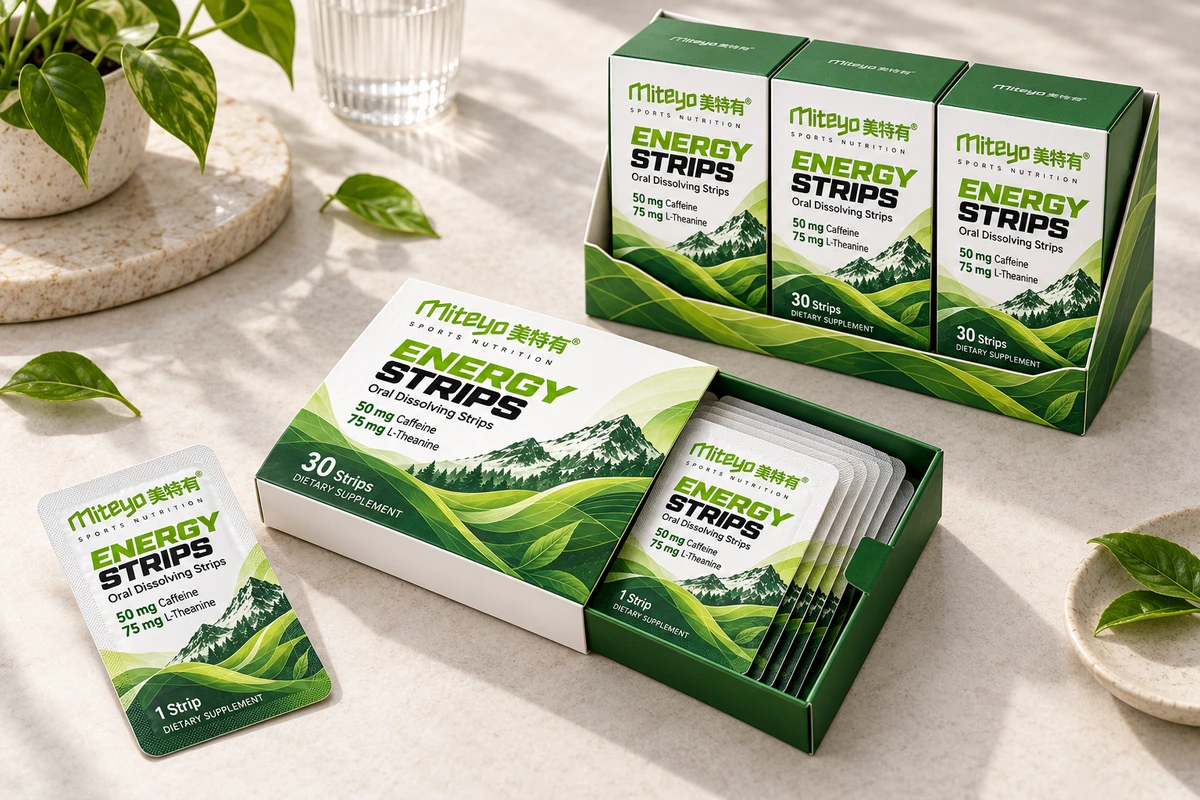
Private label oral-strip manufacturing cost depends on the formula, production scope, quality requirements, primary wrapper and retail configuration, not simply the number of strips ordered. A useful quotation separates recurring product costs from development and setup charges, then states exactly what one quoted unit includes. Compare offers on the same ingredient brief, strips per serving, strips per carton, packaging specification and delivery basis. Ask which tests, artwork activities, freight costs and other items are included or excluded. Without those definitions, a low per-strip figure may not represent a lower delivered cost. MITEYO quotations should be requested for a specific project; this guide provides a budgeting framework, not a price list, MOQ promise or fixed commercial lead time.
“Unit” can mean an unwrapped film, an individually wrapped strip, a retail carton or a finished display. Put the definition directly beside every quoted number. A spreadsheet cannot produce a meaningful comparison if suppliers are pricing different deliverables.
Also distinguish purchased quantity from usable inventory. Ask whether the quotation refers to ordered, produced, accepted or shipped units and how any agreed overrun or shortage is handled. Do not assume the treatment of production losses or rejected packaging. Those terms should be clarified in the commercial scope.
The MITEYO oral-strip platform is the commercial starting point for a quotation. Provide a versioned brief so that a later formula or packaging revision does not silently invalidate the cost comparison.
Ingredient sourcing is only part of the formulation-related cost. The film system, sensory development and processing requirements also belong in the discussion. Ask whether the quote assumes a defined input specification and whether a requested ingredient grade is available for the project.
A cheaper material is not automatically an equivalent substitution. Clarify how a proposed change affects the approved specification, supporting documents and sample work. The purchasing team should not accept a substitution solely because the commercial ingredient name appears similar.
Ask what manufacturing activities are included and how the quotation handles setup, process losses and quality release. Avoid assuming a universal scrap rate or production yield. A project-specific estimate should explain the basis for the commercial calculation without presenting an unverified rate as a fact.
Development samples and commercial batches can have different scopes. Keep charges for sample preparation or formulation iterations visible rather than assuming they disappear into the eventual unit cost. Ask what is credited, what is non-recurring and what triggers an additional charge.
The individual wrapper protects and presents the strip; the carton organizes retail units; a display supports a particular sales environment. Each has its own specification and artwork implications. Review the oral-strip packaging options before treating packaging as a single line labeled “box.”
Changing the print design, material specification or pack configuration can change the quotation. An attractive paper carton does not remove the need to evaluate the primary moisture-protective package. Keep protective performance and opening usability in the same packaging brief.
| Cost area | What to clarify | Comparison trap |
|---|---|---|
| Ingredients and film materials | Input specifications and what the quoted formulation includes | Comparing different ingredient preparations |
| Processing and packing | Activities, accepted-output basis and loss treatment | Assuming an unwrapped strip equals a finished unit |
| Wrapper and printing | Material, print variants and setup assumptions | Treating all barrier structures as interchangeable |
| Carton and display | Count, dimensions, assembly and SKU arrangement | Comparing carton prices with display prices |
| Development | Sample scope, revisions and any separate fees | Assuming unlimited iterations are included |
| Tooling or print setup | Ownership, reuse and change charges if applicable | Treating a first-order setup as a recurring charge |
| Quality work | Agreed testing, documentation and release scope | Comparing unequal evidence packages |
| Logistics | Delivery basis, destination and exclusions | Calling an ex-factory figure a landed cost |
This checklist is an original RFQ comparison framework. It does not claim that every project will incur every listed fee. Ask the supplier to mark a line included, separately charged, not applicable or awaiting definition.
Consider three planning scenarios: 10, 20 or 30 individually wrapped strips per retail carton. These are arithmetic examples, not a statement that all three configurations are available, validated or equally economical for your formula.
If the quote is for a wrapped strip, multiply that figure by the strip count to establish only the strip component of the carton cost. Then account for the carton and any other separately quoted activities. If the supplier has already quoted a finished carton, do not add those components a second time.
A larger pack might spread some packaging costs differently, but that does not automatically make it a better product. Consider the intended routine, channel presentation and how quickly a buyer expects inventory to move. Pack count is both a commercial and a customer decision.
Suppose a planning brief describes 30 individually wrapped strips per carton, with 10 cartons of each of five SKUs in one display. That would mean 50 cartons and 1,500 strips in the illustrated display configuration. The multiplication is exact; the physical and commercial feasibility of the display is not established by the arithmetic.
Ask whether the proposed dimensions, weight, merchandising use and shipping protection are practical. Confirm how mixed-SKU assembly is quoted and whether display replenishment uses the same arrangement. This example is not an approved MITEYO assortment, price offer or manufacturing minimum.
If quotations use different pack counts, normalize them in a comparison sheet while keeping the original quoted units visible. Label calculated values as calculations. A normalized value can help compare offers, but it should not erase differences in testing, materials or delivery responsibilities.
Send the same brief to every shortlisted supplier. Include target countries, intended positioning, ingredient specifications and desired amounts, strips per serving, pack-count alternatives, artwork variants and the expected first-order mix. State the delivery destination and the commercial basis you want quoted.
Then ask each supplier to return the following:
An unresolved line is better than an apparently complete quote based on incompatible assumptions. Keep a clarification log and request a revised written offer when a material assumption changes.
A common artwork system, fewer initial print variants and a focused first assortment may simplify the project. Ask for the implications rather than assuming a predetermined discount. Quantity decisions remain subject to supplier confirmation and the brand's inventory risk.
Avoid removing protective packaging or necessary quality work simply to reach an attractive headline number. Instead, challenge complexity that does not improve the customer proposition: redundant pack sizes, unnecessary decorative finishes or too many simultaneous variant changes.
Formula changes should return to technical review. A cost-saving proposal that alters flavor, input grade or packaging material may affect earlier sample conclusions. Assign someone to confirm which specifications and evidence remain applicable before the revised quotation is accepted.
Ask what the supplied documentation actually covers: the relevant material, batch, process or finished product. A general brochure should not be counted as a project-specific test package. FDA's dietary-supplement CGMP guidance explains the role of specifications and quality controls for the US context. It is not evidence of a particular manufacturer's certification or of compliance by an unreviewed product.
For overseas purchases, assign responsibility for destination-market label review, import-related work and local distribution costs. Those responsibilities affect a usable budget even when they are not part of the manufacturing quotation.
A useful quote needs a defined project. Formula, wrapper, retail configuration, order assumptions and testing scope can differ. Request a written quotation rather than relying on a generic price displayed without those conditions.
Not necessarily on the comparison that matters to your business. Per-strip and per-carton costs answer different questions. Compare equivalent specifications and consider the intended retail offer and inventory commitment.
Do not assume so. Ask which activities are included, separately charged or not applicable, and whether a later artwork or formula change creates another charge.
Normalize the finished unit and retain a separate list of inclusions, exclusions and unresolved assumptions. Resolve meaningful scope differences before treating the figures as directly comparable.
Prepare your formula brief, destination market, pack-count options and proposed SKU mix. Request a Quote from MITEYO and ask for a clear breakdown of the development, packaging and quality scope. The goal is a budget you can defend, not an unsupported headline price.