
ARTICLE CONTENT
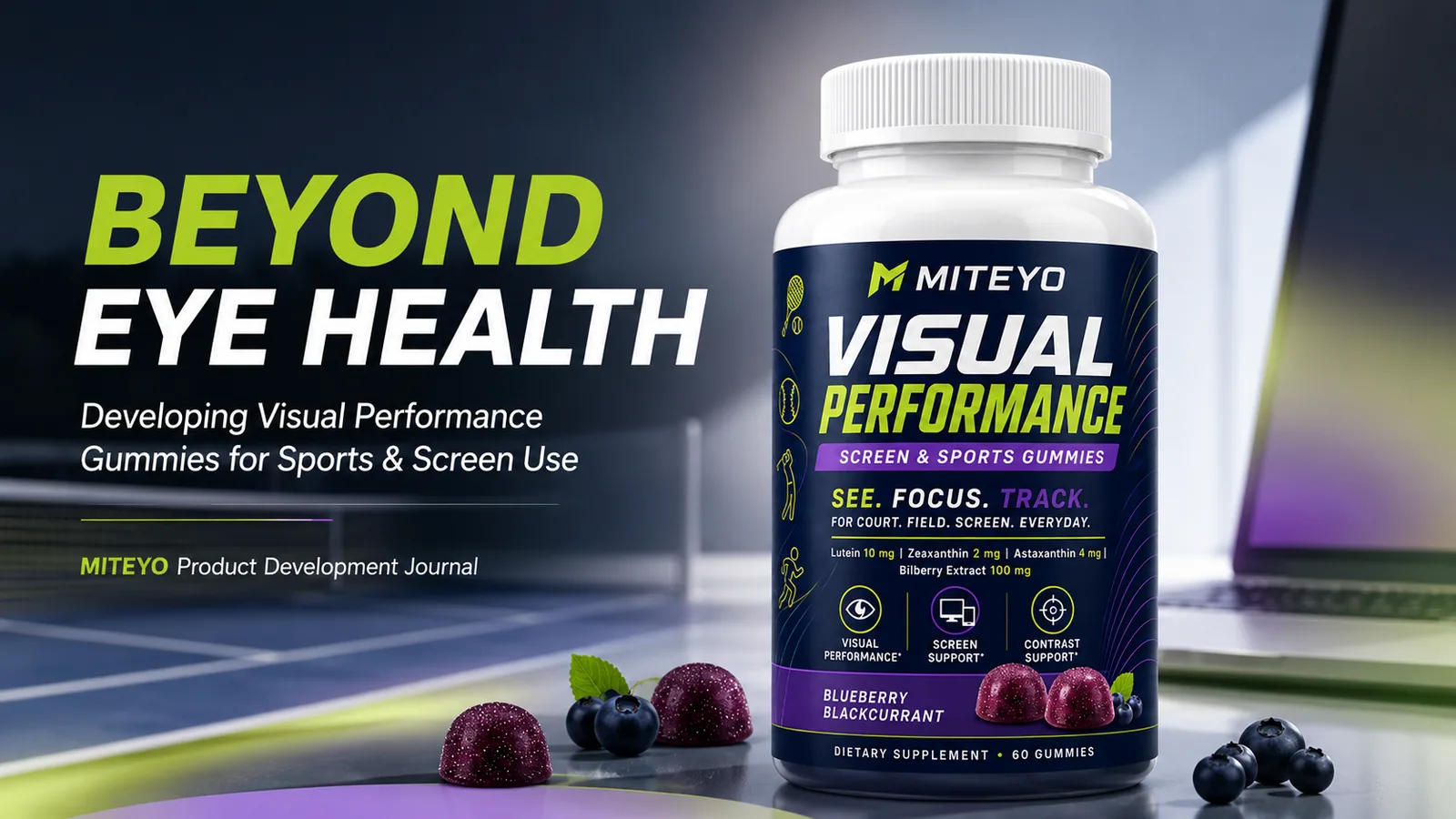
Beyond Eye Health: Developing Visual Performance Gummies for Sports & Screen Use
From the MITEYO Product Development Team
Most lutein gummies on the market are positioned around one familiar idea: general eye health.
That positioning makes sense, but it may leave a much broader product opportunity unexplored.
Modern consumers do not use their eyes in only one environment. A professional may spend eight hours in front of a computer, check a smartphone throughout the day, then play tennis, golf, pickleball, baseball, run outdoors, cycle, or train after work.
In both digital and sports environments, visual demands can include tracking moving objects, adapting to changing light, maintaining contrast perception, recovering from glare, and processing visual information efficiently.
This raises a product-development question:
Can a traditional eye-health gummy be reformulated and repositioned as a visual performance supplement for both sports and screen-heavy lifestyles?
That is the concept our product development team is currently evaluating.

From Eye Health to Visual Performance
Traditional eye supplements and sports-oriented visual performance supplements overlap, but they are not necessarily the same product.
| Traditional Eye Health Supplement | Visual Performance Concept |
|---|---|
| General eye wellness | Visual performance support |
| Often targeted to older adults | Active adults and sports consumers |
| Frequently capsules or softgels | Gummy format can offer differentiation |
| Clinical or healthcare-oriented branding | Sports and active-lifestyle positioning |
| General daily maintenance | Sports + screen use cases |
| Eye-health messaging | Contrast, glare and visual-function support |
The distinction matters.
For a sports nutrition company, simply adding lutein to a gummy does not automatically create a sports product. The formulation, delivery system, branding, sensory profile, serving format and claims strategy all need to support the intended positioning.
Our working concept is therefore broader than an ordinary “eye gummy”:
VISUAL PERFORMANCE + SCREEN & SPORTS
For Court. Field. Screen. Everyday.
Why Visual Performance Is Relevant to Sports
Visual information influences many sports situations.
A tennis player follows ball speed and trajectory.
A baseball player may have only fractions of a second to process an approaching pitch.
A golfer performs under changing outdoor light and glare.
Cyclists and runners regularly transition between sunlight, shade and changing environments.
Racket-sport players continuously combine visual tracking with body positioning and reaction.
Research has also explored the relationship between macular carotenoids and visual performance.
A randomized placebo-controlled study in young healthy adults reported improvements in measures of visual processing speed following lutein and zeaxanthin supplementation.
Another randomized, double-blind, placebo-controlled trial using 10 mg lutein and 2 mg zeaxanthin per day investigated outcomes including photostress recovery, glare disability and chromatic contrast.
These findings do not mean a supplement can turn someone into a better athlete. They do, however, provide a scientific basis for exploring visual nutrition as part of a broader performance-nutrition category.
Screen Use Creates a Second Consumer Need
Sports are only half of the opportunity.
The same consumer who trains in the evening may spend most of the working day in front of digital displays.
In a 2025 randomized, double-blind, placebo-controlled study of adults using electronic screens for more than six hours per day, supplementation with 10 mg lutein plus 2 mg zeaxanthin isomers was associated with improvements in several measured eye-related outcomes, including photostress recovery time and tear-related measures.
This creates an interesting crossover category:
Sports nutrition + digital lifestyle nutrition
Instead of developing a product only for professional athletes, brands can consider a much broader active consumer:
Office professionals
Recreational athletes
Tennis and racket-sport players
Golfers
Baseball and softball players
Cyclists
Runners
Fitness consumers
Gamers and esports users
Consumers with prolonged daily screen exposure
For product developers, that broader use case may make the concept commercially more flexible than a supplement built around one specific sport.
Building a Practical Visual Performance Gummy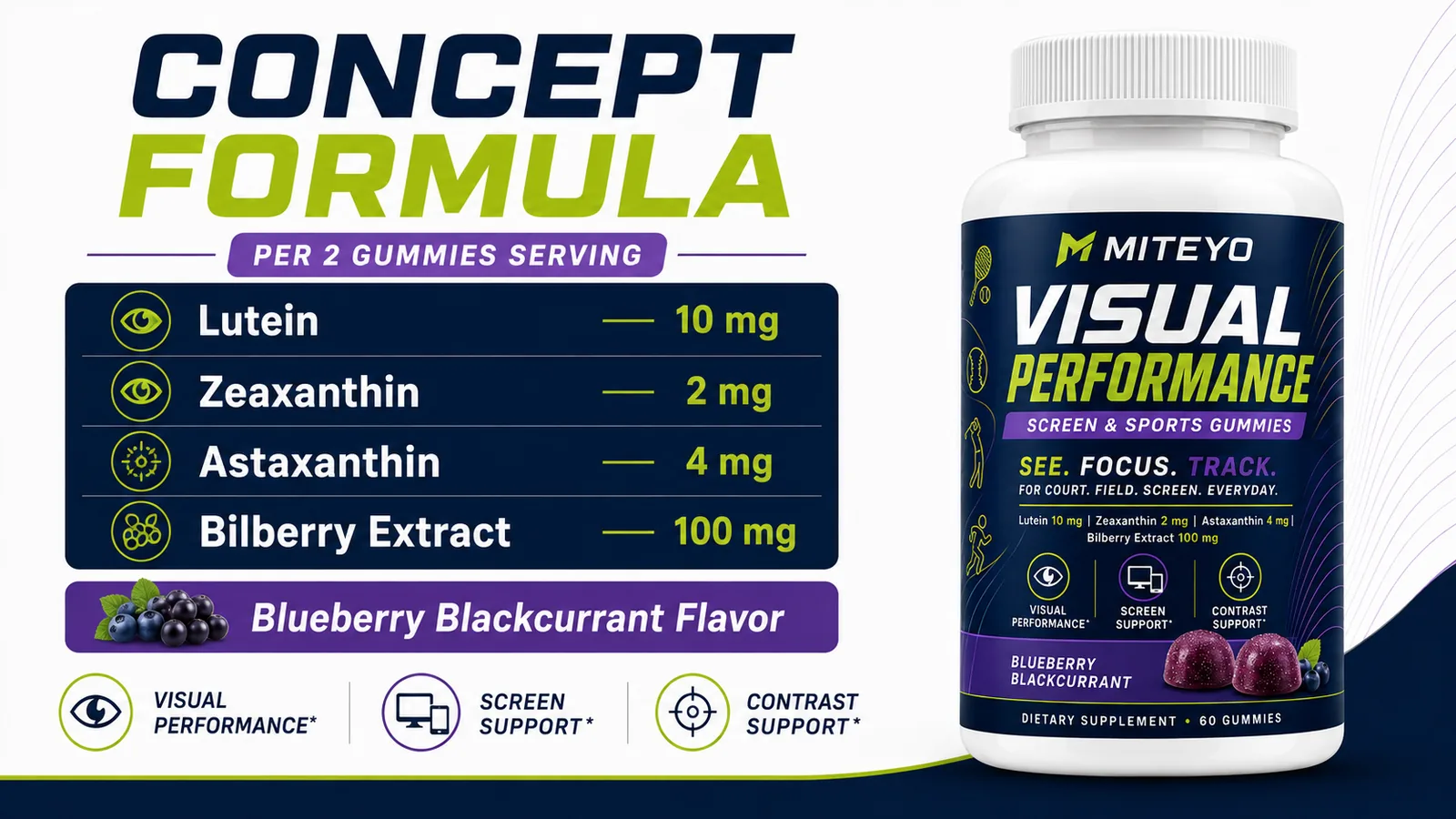
A successful gummy formula cannot be designed only by selecting ingredients that sound attractive on a label.
Each active ingredient affects manufacturing.
The development team has to consider:
dosage → raw-material assay → processing → taste → color → texture → stability → finished-product testing
For our current concept-development work, one formula being evaluated is:
Concept Formula — Per 2-Gummy Serving
| Active Ingredient | Concept Amount |
|---|---|
| Lutein | 10 mg |
| Zeaxanthin | 2 mg |
| Astaxanthin | 4 mg |
| Bilberry Extract | 100 mg |
Serving concept: 2 gummies daily
Target gummy weight: approximately 3.2–3.8 g each
Flavor direction: Blueberry + Blackcurrant
Target market: United States
This is a development concept, not a finalized commercial specification. Final amounts depend on raw-material specifications, assay, processing loss, stability testing, sensory performance and regulatory review.
1. Lutein + Zeaxanthin: The Foundation
Lutein and zeaxanthin are carotenoids concentrated in the macular region of the retina and are widely used in eye-health supplements.
For the current concept, we selected:
Lutein — 10 mg
Zeaxanthin — 2 mg
The 10:2 mg combination is particularly interesting because this dosage has been used in controlled human studies investigating visual outcomes.
For a gummy manufacturer, however, the label amount is only part of the problem.
The development team must also verify:
Raw-material concentration
Lutein source
Free lutein versus lutein ester specification
Actual active assay
Carrier system
Processing stability
Required overage
Finished-product analytical method
For example, 10 mg of a lutein-containing raw material is not necessarily equal to 10 mg of declared lutein.
This distinction becomes critical when moving from a concept formula to a commercially compliant Supplement Facts panel.
2. Astaxanthin: Attractive, but Technically More Demanding
Astaxanthin adds another potential visual-performance and antioxidant dimension to the formulation.
Research has examined combinations containing astaxanthin, lutein and zeaxanthin in people exposed to visual display terminals, including measures related to eye-hand coordination and smooth-pursuit eye movement.
But from a manufacturing perspective, astaxanthin introduces additional questions.
It can be sensitive to:
Heat
Light
Oxygen
Raw-material carrier systems
Long-term storage conditions
The correct formulation question is therefore not simply:
“Can we put 4 mg astaxanthin into the gummy?”
It is:
Can the intended amount remain within specification after processing and throughout the intended shelf life?
That requires raw-material selection, processing control and stability planning.
3. Bilberry: Useful Story, Real Formulation Challenges
Bilberry is familiar to consumers in the visual-support category and provides a logical berry-based connection to the product.
For this concept, we are evaluating:
Bilberry Extract — 100 mg per serving
However, botanical extracts can affect more than the Supplement Facts panel.
Depending on the extract specification and anthocyanin concentration, bilberry may influence:
Bitterness
Astringency
Finished gummy color
Flavor balance
Gel strength
Moisture behavior
This is why the phrase “100 mg bilberry extract” is not enough for a manufacturing specification.
The supplier specification, extraction ratio, standardization and marker compounds must also be considered.
Why We Would Not Automatically Choose a Pectin-Only Gummy
Pectin has become highly popular in the supplement industry, particularly for vegan gummies.
But “pectin” should not automatically be treated as synonymous with “premium gummy.”
A high-active gummy must achieve several sensory and physical targets simultaneously:
Low stickiness
Clean bite
Appropriate elasticity
Controlled chewiness
Good flavor release
Room-temperature stability
Commercial manufacturability
Depending on the formulation and process, a pectin gummy can sometimes become softer or more adhesive than the desired texture profile.
For this Visual Performance concept, we are therefore evaluating plant-based mixed hydrocolloid systems rather than automatically specifying pure pectin.
Exploring Carrageenan + Plant Gum Systems
One development route under evaluation combines carrageenan with other plant-derived hydrocolloids, such as:
Konjac gum
Locust bean gum
Other compatible plant gums
The objective is not simply to create a firmer gummy.
The target sensory profile is:
Chewy, elastic, low-stickiness and clean-biting — without becoming a jelly.
A mixed plant-gum approach may also provide additional commercial positioning advantages.
Depending on the complete ingredient supply chain and certification status, the formulation can potentially support:
Halal-compatible formulation
Vegan-friendly formulation
For international supplement brands, that can be more valuable than choosing a gelling system based only on ingredient trends.
Why Gummy Texture Matters in Sports Nutrition
Texture is often treated as a secondary consideration during supplement development.
It should not be.
The consumer does not experience a laboratory formula.
The consumer experiences:
appearance → aroma → first bite → chew → flavor → aftertaste
A technically impressive formula that sticks heavily to the teeth or leaves a strong botanical aftertaste may not perform well commercially.
For this reason, our development brief asks the gummy R&D team to evaluate several factors independently:
Stickiness
Does the gummy adhere excessively to the teeth?
Elasticity
Does it recover after compression without becoming rubbery?
Bite-off
Does the gummy break cleanly when chewed?
Chewiness
Is the texture substantial enough to feel like a gummy rather than a jelly?
Flavor masking
Can berry flavors effectively balance the botanical and carotenoid ingredients?
Shelf behavior
Does the texture remain acceptable during storage?
These are manufacturing questions that cannot be answered by reading an ingredient list.
They require actual sampling and evaluation.
Why Blueberry + Blackcurrant?The original product inspiration for this development project used a blueberry-oriented eye-health concept.
Rather than removing that connection completely, we are evaluating a more mature:
Blueberry + Blackcurrant
flavor direction.
There are several reasons.
First, dark berry flavors naturally align with bilberry.
Second, they can support a deep berry-purple product identity.
Third, stronger berry flavor systems may provide useful masking for botanical extracts.
Most importantly, the flavor fits both visual wellness and sports lifestyle positioning without making the product appear targeted to children.
Sports + Screen May Be More Powerful Than Sports AloneA sports-only visual supplement is interesting.
A sports and screen supplement may offer a substantially broader brand story.
Consider one consumer:
A 35-year-old professional works on a laptop for much of the day.
Between meetings, the consumer checks a smartphone.
After work, the same person goes to a tennis court, golf course, gym or running trail.
There is no clear boundary between the person's “digital lifestyle” and “active lifestyle.”
That is why our concept positioning evolved from:
SPORTS VISION
toward:
VISUAL PERFORMANCESCREEN & SPORTS
with the communication platform:
SEE. FOCUS. TRACK.
FOR COURT. FIELD. SCREEN. EVERYDAY.
This allows brands to speak to performance consumers without restricting the product to one sport.
U.S. Claims Require DisciplineFormulation is only one part of developing a dietary supplement for the United States.
Claims matter.
A dietary supplement should not casually make disease-treatment claims such as:
Prevents macular degeneration
Treats eye disease
Prevents myopia
Cures digital eye strain
FDA distinguishes disease claims from permitted structure/function claims.
Structure/function claims can describe how a dietary ingredient supports normal body structure or function, but the company making the claim must have appropriate substantiation, the claim must be truthful and not misleading, and applicable FDA notification and disclaimer requirements must be followed.
Potential positioning concepts therefore need to be evaluated carefully.
Examples for regulatory review might include:
Supports Visual Performance*
Supports Normal Visual Function*
Supports Contrast Sensitivity*
Supports Eye Health During Screen Use*
The final wording should always be reviewed against the finished formula and available substantiation before commercialization.
What Supplement Brands Should Evaluate Before SamplingBefore asking a gummy manufacturer for a sample, brands should define more than the ingredient list.
For a Visual Performance gummy, we recommend evaluating at least these ten areas:
Target active amount per daily serving
Raw-material potency and assay
Gummy weight and number of gummies per serving
Heat sensitivity of the active ingredients
Expected manufacturing loss and overage strategy
Flavor-masking requirements
Gelling system and texture target
Halal, vegan or other certification requirements
Finished-product assay and microbiological testing
Shelf-life and stability plan
A formula that looks attractive in Excel still has to survive manufacturing.
That is where product development begins.
Concept to Commercial Production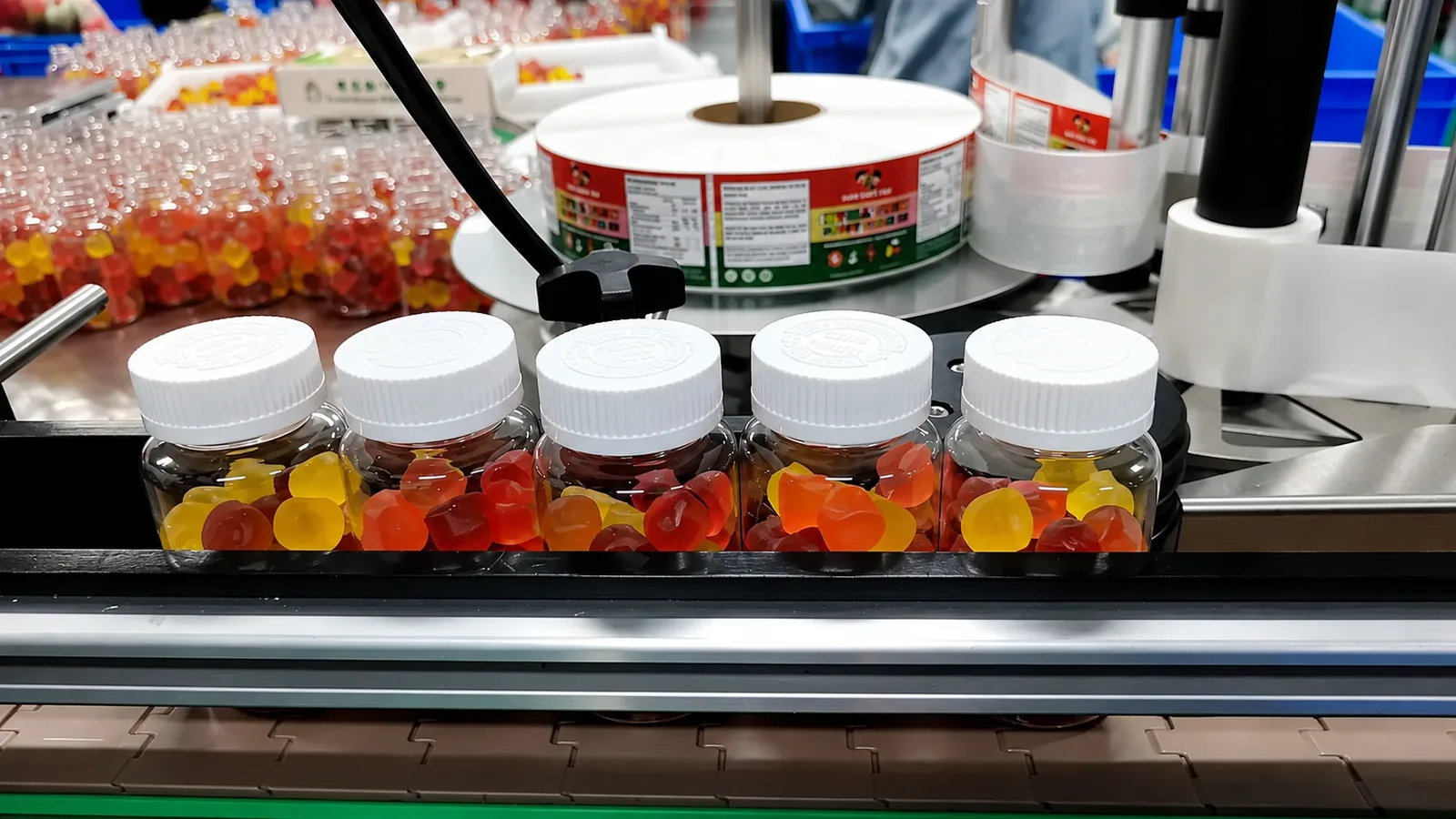
For this project, our development pathway is:
Concept Positioning
↓
Ingredient & Dosage Selection
↓
Raw Material Assessment
↓
Gelling-System Development
↓
Laboratory Sampling
↓
Taste & Texture Evaluation
↓
Active-Ingredient Testing
↓
Stability Evaluation
↓
U.S. Label & Claims Review
↓
Packaging Development
↓
Commercial Production
This process also explains why we do not recommend designing a final label before the formulation is confirmed.
Serving size, sugar system, ingredient declaration and Supplement Facts data may change during development.
The package should follow the formula — not force the formula to fit an already printed package.
Can Visual Performance Ingredients Be Made Into Gummies?Yes — but successful gummy development requires more than putting lutein, zeaxanthin and botanical extracts into a candy base.
Manufacturers need to evaluate active concentration, raw-material assay, heat exposure, oxidation, flavor masking, gel interaction, finished-product potency and shelf-life stability.
That difference separates a concept gummy from a commercially scalable dietary supplement.
For sports nutrition brands looking beyond creatine, hydration and pre-workout products, Visual Performance represents an interesting area to explore because it connects three established consumer behaviors:
daily supplementation + active lifestyle + heavy screen use
Whether it ultimately becomes a large standalone category remains to be seen.
But from a product-development perspective, it offers something increasingly difficult to find in sports nutrition:
a genuinely different conversation.
Developing a Visual Performance Gummy?MITEYO works with supplement brands on custom sports nutrition gummy development, including formulation assessment, active-ingredient selection, texture development, flavor systems, sampling, packaging and commercial manufacturing.
If your brand is exploring a Visual Performance, Sports Vision or Screen Support gummy, our product development team can evaluate the concept based on your target market, dosage, claims direction, certification requirements and budget.
Looking for a Custom Visual Performance Gummy Manufacturer?
MITEYO provides custom gummy formulation, OEM/ODM manufacturing, flavor development, plant-based gelling systems, Halal-compatible formulation, packaging and commercial production for supplement brands.
References
Bovier ER, Hammond BR. A randomized placebo-controlled study on the effects of lutein and zeaxanthin on visual processing speed in young healthy subjects. Archives of Biochemistry and Biophysics. 2015.
Hammond BR, et al. A double-blind, placebo-controlled study on the effects of lutein and zeaxanthin on photostress recovery, glare disability, and chromatic contrast.
Lopresti AL, et al. The effects of lutein/zeaxanthin on eye health, eye strain, sleep quality, and attention in high electronic screen users: a randomized, double-blind, placebo-controlled study. Frontiers in Nutrition. 2025.
Effects of Astaxanthin, Lutein, and Zeaxanthin on Eye-Hand Coordination and Smooth-Pursuit Eye Movement after Visual Display Terminal Operation in Healthy Subjects: A Randomized, Double-Blind Placebo-Controlled Intergroup Trial.
U.S. Food and Drug Administration. Structure/Function Claims.
U.S. Food and Drug Administration. Dietary Supplement Labeling Guide.