Gummies vs Powders: How to Choose the Right Format for a Sports Nutrition Product
Compare gummies and powdered drink mixes by active load, serving experience, packaging, stability, MOQ and product positioning before starting OEM/ODM development.
 Start a project ↗
Compare gummies and powdered drink mixes by active load, serving experience, packaging, stability, MOQ and product positioning before starting OEM/ODM development.
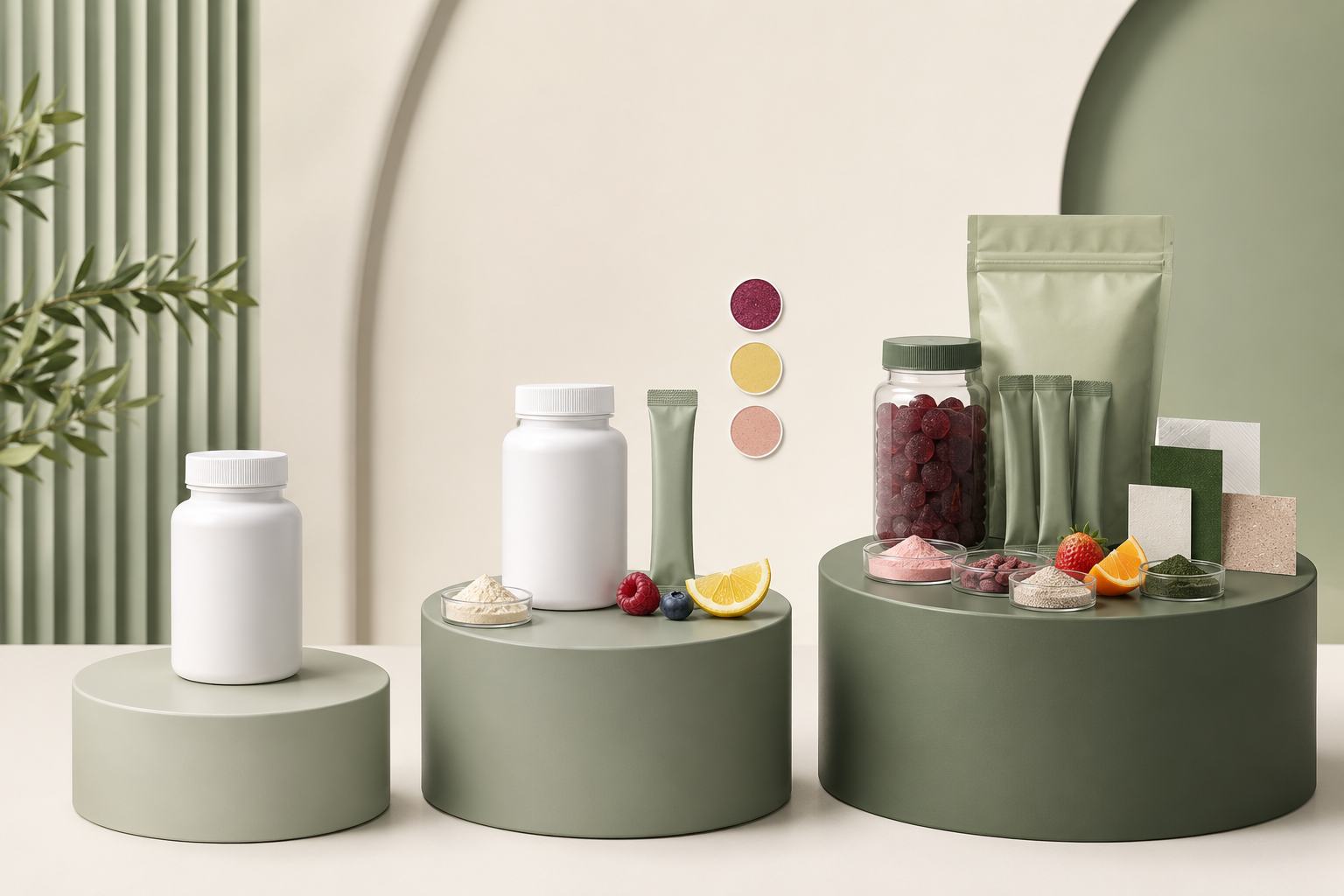
Gummies are strongest when convenience, taste, portability and daily habit formation are central to the concept. Powders are usually stronger when the formula requires a larger active load, flexible serving size or consumption with water. The right format should be selected from the target serving, consumer use occasion and commercial model—not from packaging preference alone.
Sports nutrition brands often begin product development with a familiar request:
“Can you make this formula as a gummy?”
That is the wrong first question.
The correct question is:
“Which dosage form can credibly deliver the intended serving in the way the consumer will actually use it?”
A format can look attractive while creating problems with dose, taste, texture, packaging, testing or cost. Choosing the dosage form early—and choosing it for the right reasons—reduces redevelopment later.
Every dosage form has a practical capacity.
A gummy must contain the active ingredients as well as its gelling system, sweeteners, water, acids, flavors, colors and processing components. When the desired active load rises, the development team may need to increase gummy weight, increase gummies per serving or reduce the formula.
A powder has more formulation space. This makes powders more suitable for products built around gram-level servings, multiple minerals, amino acids, protein, carbohydrate or other high-load ingredients.
The correct sequence is:
Define the intended amount of each active ingredient per daily serving.
Confirm the maximum acceptable serving count or scoop size.
Evaluate whether the formula fits the proposed format.
Only then finalize flavor, shape, package size and front-label communication.
| Decision factor | Gummies | Powdered drink mixes |
| Active-load capacity | More limited | Generally higher |
| Consumer preparation | No mixing | Requires water or another liquid |
| Portability | Strong, especially in bottles or pouches | Strong in stick packs; less convenient in tubs |
| Habit formation | Familiar daily ritual | Often linked to workout or hydration occasions |
| Flavor challenge | Actives affect sweetness, acidity and chew | Minerals and actives may create bitter, salty or chalky notes |
| Serving flexibility | Usually fixed by gummy count | Scoop or stick can support different serving structures |
| Packaging | Bottle, pouch, blister or sachet | Stick pack, sachet, pouch or tub |
| Heat and moisture concerns | Sticking, deformation and texture change | Caking, moisture pickup and flavor change |
| Best suited to | Daily convenience and moderate loads | Hydration and higher-load performance formulas |
This table is a screening tool, not a universal rule. A well-designed gummy can outperform a poorly designed powder, and a convenient stick pack can be more portable than a bottle of gummies.
The same ingredient can require different formats when the use occasion changes.
A consumer taking a product at home every morning may value taste and consistency more than maximum active density. Gummies can fit this behavior well.
Both gummies and single-serve powders can work. The deciding questions are whether water is available and whether consuming the product with fluid is part of the benefit.
Hydration powders have an inherent advantage because the product is consumed with water. Stick packs also fit gym bags, tournament registration packs and club retail.
Powder is frequently the more credible option. Forcing gram-level ingredients into one or two small gummies may create a serving that looks convenient but fails on dose or sensory quality.
Consumers may prefer fewer gummies, but the smallest serving count is not always the best product.
If a formula requires multiple gummies, the brand should evaluate:
total gummies per day;
bottle count and days of supply;
individual gummy weight;
consumer tolerance for the serving;
package size and shipping economics;
whether the front label clearly communicates the actual serving.
A two-gummy claim is not commercially useful if the dose is too small to support the positioning. Conversely, a six-gummy serving may provide the intended active amount but create poor repeat-use behavior.
Flavor is not an independent decoration.
Minerals may introduce saltiness, bitterness or metallic notes. Botanical extracts can introduce earthy or astringent notes. Amino acids and other performance ingredients may change sweetness, acidity and mouthfeel.
For gummies, the development team must balance active load with chew, firmness, surface finish and aftertaste. For powders, it must balance the formula with water volume, dissolution, sediment and flavor intensity.
The product brief should therefore state the expected water volume for a powder and the expected gummy weight and count for a gummy.
Packaging protects the product and defines how it is sold.
Gummy packaging may need to address moisture, oxygen, sticking, deformation and headspace. Powder packaging may need to address moisture pickup, seal integrity and caking.
The brand should consider:
destination climate;
ocean and ground transportation;
warehouse conditions;
expected shelf life;
servings per container;
sampling and trial-pack strategy;
retail shelf and e-commerce shipping requirements.
Packaging should be reviewed during formulation—not after the sample is approved.
| Question | If “yes” | Likely direction |
| Does the formula require a large gram-level serving? | Active capacity is the priority | Start with powder |
| Must the consumer drink water with the product? | Fluid intake is part of the occasion | Start with powder or stick pack |
| Is no-mix convenience the main benefit? | Portability and routine are central | Evaluate gummies |
| Is the concept intended for impulse retail or daily lifestyle use? | Experience and packaging matter heavily | Evaluate gummies |
| Are heat and humidity major distribution risks? | Package and stability need extra review | Compare both through stability testing |
| Does the brand need both trial and full-serving formats? | One format may not serve every occasion | Consider a coordinated gummy + powder system |
Before requesting a quotation, provide:
Target market and sales channel
Intended consumer and use occasion
Complete active formula per serving
Maximum gummies, scoop size or stick weight per serving
Sugar, reduced-sugar or sugar-free direction
Flavor and color preferences
Servings per container
Packaging preference
Testing and documentation requirements
Estimated first order and launch timing
Without these inputs, a supplier can provide a price, but not a reliable commercial proposal.
Gummies and powders are not competing answers to every product brief. They solve different product problems.
The strongest format is the one that creates a credible relationship between ingredient amount, serving behavior, sensory quality, packaging and price.
MITEYO develops sports nutrition gummies and powdered drink mixes through Ready-to-Brand, Semi-Custom and Full ODM programs.
Planning a new sports nutrition product?
Send us your target formula, serving, market, format preference and estimated first order for a formulation-feasibility review.
Internal links to add:
Gummies → /dosage-forms/gummies/
Powders → /dosage-forms/powders/
Dosage Forms → /dosage-forms/
OEM / ODM → /oem-odm/