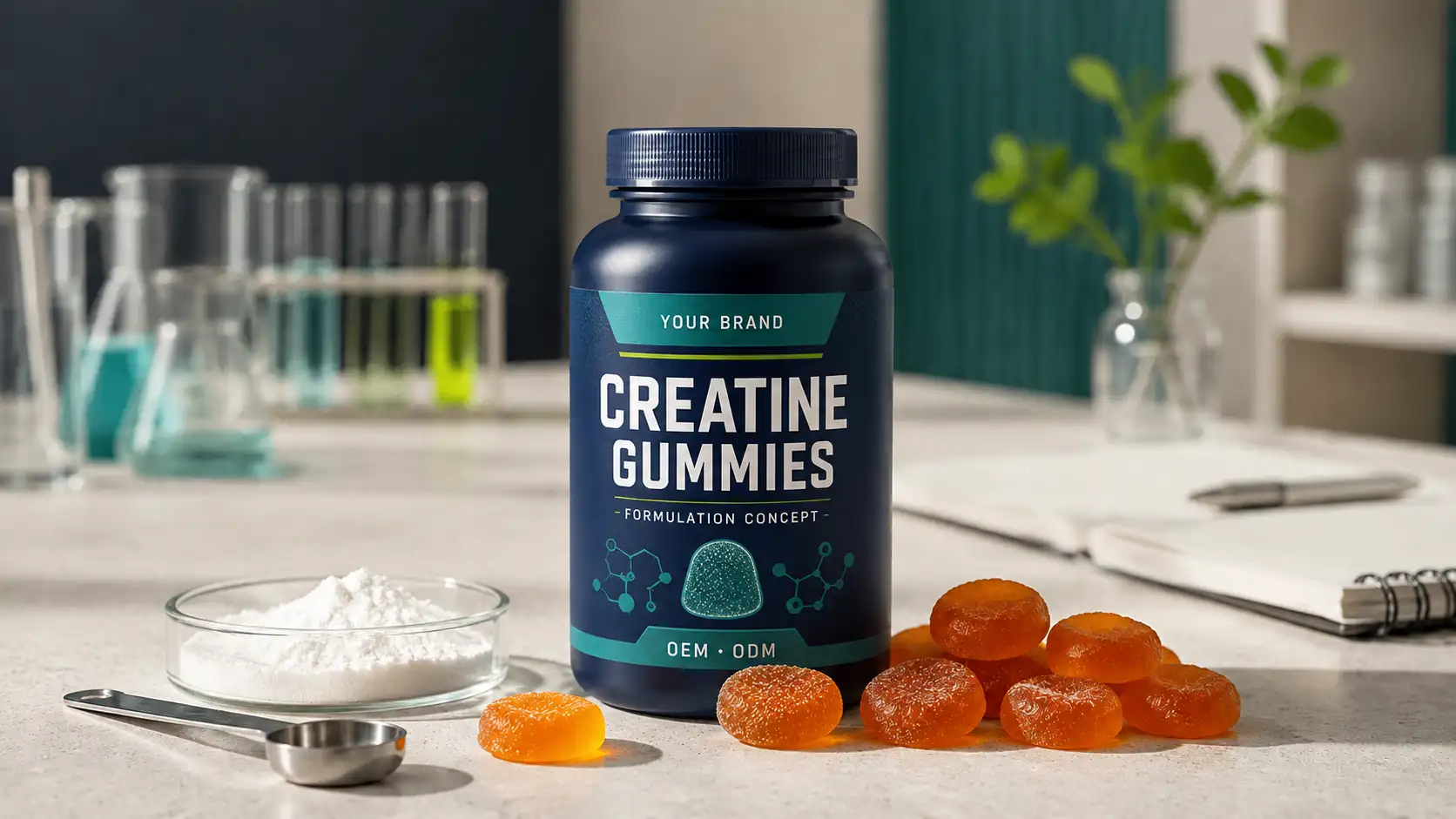
<b>Creatine gummies are attractive because they turn a familiar sports nutrition ingredient into a portable and consumer-friendly daily format. But a gummy should not be developed by choosing an appealing bottle and adding a small amount of creatine simply to support a marketing claim.
The real development question is:
**Can the intended creatine serving fit into a gummy format while maintaining acceptable taste, texture, stability, serving count and commercial cost?**
For brands considering creatine gummy OEM or ODM development, the target daily serving should be established before the gummy size, count and packaging are finalized.
## 1. Start with the target daily serving
Creatine monohydrate is widely used in sports nutrition. Published reviews commonly discuss daily creatine intakes in the range of 3–5 grams for increasing or maintaining muscle creatine stores.
This does not mean that every creatine gummy must contain exactly the same amount. It does mean that a brand should clearly define:
* The intended amount of creatine per serving
* The number of gummies per serving
* The expected daily consumption routine
* The type and grade of creatine used
* The claims that can be supported by the finished specification
A product containing only a token amount of creatine may be easy to manufacture, but it can create a gap between the front-label impression and the actual Supplement Facts panel.
The creatine amount should therefore be visible and commercially credible—not hidden behind vague “creatine blend” language.
## 2. Why creatine is difficult to fit into a gummy
A gummy has limited physical capacity. Its total weight must accommodate more than the active ingredient.
The formulation also needs room for:
* Gelling materials such as pectin or gelatin
* Sweeteners and soluble solids
* Water and processing aids
* Acids and buffering components
* Flavor and color systems
* Coating or finishing ingredients
* Other functional ingredients, when applicable
Increasing the creatine load can affect:
* Gummy size and weight
* Texture and chewability
* Flavor intensity
* Surface appearance
* Processing consistency
* Moisture behavior
* Stability during storage
This is why the desired creatine amount, gummy count and sensory target must be evaluated together.
A high daily serving combined with only one or two small gummies may not be a realistic product brief.
## 3. Serving count is a product decision—not just a label decision
Consumers generally prefer fewer gummies, but forcing a large creatine amount into an unrealistically small serving can damage the product experience.
Brands should compare several possible structures:
### Lower gummy count
This format may offer stronger convenience, but it can require larger or denser gummies and may create greater flavor and texture challenges.
### Multi-gummy serving
Distributing the active load across more gummies may improve manufacturing feasibility and sensory quality. However, it increases the number of gummies consumed per day and may require a larger package.
### Powder or dual-format system
When the target dose does not fit comfortably into a gummy, a powdered drink mix may be the more credible delivery system.
Some brands may also develop coordinated formats:
* Gummies for portability and routine
* Powder for higher-load or full-serving use
The correct format should follow the intended serving—not the other way around.
## 4. Creatine source and specification matter
“Creatine” is not a complete raw-material specification.
Before quotation and sampling, the development team should confirm:
* Ingredient form
* Creatine assay or purity specification
* Particle-size requirements
* Supplier documentation
* Country-of-origin requirements
* Testing expectations
* Finished-product declaration
* Target-market labeling requirements
Creatine monohydrate is the most established and commonly studied form, but the exact ingredient and supplier still need to be confirmed for the commercial project.
A branded or premium raw material may support differentiation, although it can also affect cost, sourcing lead time and minimum order quantity.
## 5. Flavor and texture cannot be evaluated separately
A creatine gummy is not simply a standard gummy with creatine mixed into it.
The active load can influence the gummy’s taste and physical characteristics. Flavor development may need to balance:
* Sweetness
* Acidity
* Residual mineral or ingredient notes
* Fruit flavor intensity
* Chew firmness
* Stickiness
* Surface drying
* Aftertaste
Strong masking is not automatically better. Excessive sweetness or acidity can make the first bite appealing while creating a poor daily-use experience.
Because creatine is usually consumed consistently, repeat-use acceptability matters more than an exaggerated first impression.
## 6. Stability should be reviewed before commercial production
A successful initial sample does not automatically prove that the product will remain acceptable throughout its intended shelf life.
The development plan should consider:
* Creatine content through shelf life
* Moisture and water activity
* Gummy hardness or softening
* Sticking and deformation
* Color and flavor change
* Microbiological specifications
* Packaging barrier performance
* Storage and shipping temperature
Accelerated and real-time stability plans should be selected according to the formula, packaging, target shelf life and destination market.
Shipping climate is especially relevant for gummy products. A formula that performs well in a controlled sample room may behave differently during summer transportation or warehouse storage.
## 7. Packaging affects both stability and commercial positioning
Bottle count should be calculated from the actual serving structure.
For example, the brand needs to determine:
* Gummies per serving
* Servings per container
* Total gummy count
* Individual gummy weight
* Required bottle or pouch volume
* Moisture-protection requirements
* Desiccant or other packaging components
* Label-panel space
A low gummy count may allow a compact bottle, while a higher-dose, multi-gummy serving may require a larger package.
The package should not visually imply a full month’s supply if the actual serving count provides significantly fewer days of use.
Commercial credibility includes clear serving economics.
## 8. Claims must follow the finished product
Marketing language should be developed after confirming the formula, serving and testing plan.
For the U.S. market, structure/function claims must be truthful, not misleading and appropriately substantiated. Disease-treatment or disease-prevention claims should not be used for a conventional dietary supplement.
The label and marketing review should consider:
* Ingredient identity
* Amount per serving
* Supplement Facts declaration
* Directions for use
* Required disclaimer
* Target consumer
* Substantiation for proposed claims
* Consistency between the website, packaging and sales materials
A scientifically familiar ingredient does not make every possible marketing statement acceptable.
## 9. What brands should provide before requesting a quotation
A useful creatine gummy brief should include:
1. Target market and sales channel
2. Target creatine amount per daily serving
3. Maximum acceptable gummies per serving
4. Pectin or gelatin preference
5. Sugar or sugar-free direction
6. Preferred flavor, color and gummy shape
7. Gummies or servings per container
8. Bottle, pouch or other packaging preference
9. Testing and documentation requirements
10. Estimated first order and target launch date
Without these inputs, a quotation may look precise while being based on an undefined product.
## 10. The right development sequence
A practical creatine gummy development process normally follows this order:
1. Confirm the target consumer and market
2. Define the target daily creatine serving
3. Review gummy capacity and serving count
4. Select the ingredient specification
5. Develop flavor and texture direction
6. Produce and evaluate samples
7. Confirm testing and stability requirements
8. Finalize packaging and label information
9. Approve the commercial specification
10. Begin production and finished-batch review
Changing the active load after flavor, packaging or pricing approval can cause avoidable redevelopment.
## Build the serving before building the claim
A credible creatine gummy does not need to copy every product already on the market. It needs to provide a clear and defensible relationship between the formula, serving size, consumer routine and label communication.
If the requested dose does not fit the intended gummy count, the development team should say so early and recommend a more realistic multi-gummy serving, powder format or coordinated product system.
MITEYO develops sports nutrition gummies and powdered drink mixes through Ready-to-Brand, Semi-Custom and Full ODM programs.
**Planning a creatine gummy project?**
Send us your target serving, preferred gummy count, packaging direction and estimated first order for a formulation-feasibility review.
## References
* International Society of Sports Nutrition. “Common Questions and Misconceptions About Creatine Supplementation.” Journal of the International Society of Sports Nutrition, 2021.
* National Institutes of Health, Office of Dietary Supplements. “Dietary Supplements for Exercise and Athletic Performance.”
* U.S. Food and Drug Administration. “Structure/Function Claims.”
Develop a Similar Product
Have a formula, reference product or market idea? Send us the brief.Start a Project → Start a project ↗