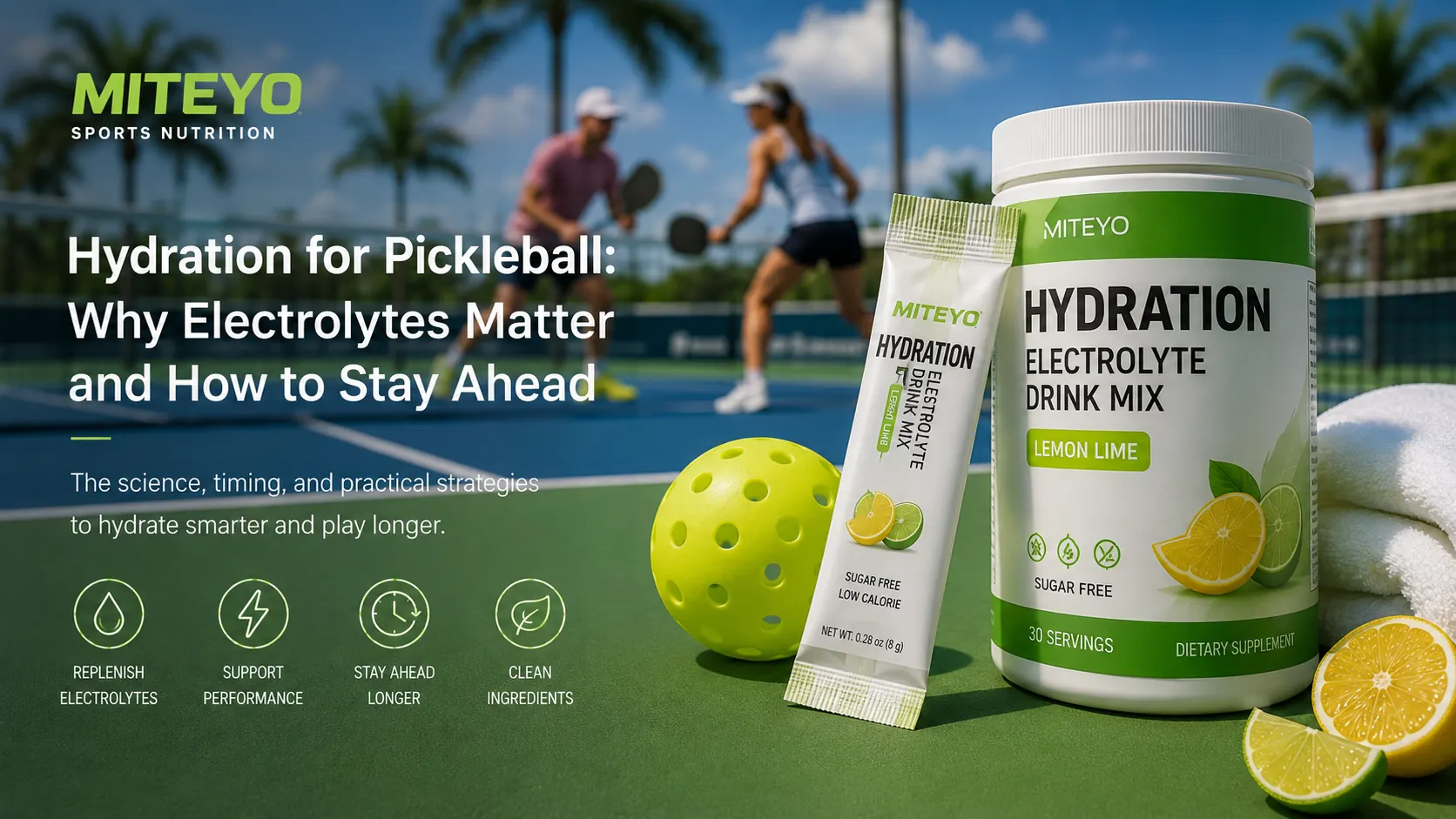
Pickleball hydration should be developed around when and how the player will use the product.
A recreational player completing a short indoor session does not necessarily need the same formula as a player spending several hours on outdoor courts in Florida, Texas or California.
The development team should therefore define:
Playing duration
Heat and humidity
Expected sweat exposure
Target sodium direction
Serving water volume
Sugar or reduced-sugar positioning
Powder, stick pack or gummy format
Flavor intensity
Number of servings carried in a court bag
Retail, club or tournament channel
Electrolyte drinks and mixes can be particularly relevant for exercise lasting longer than about an hour or prolonged activity in hot or humid conditions.
The correct product should follow the intended use occasion—not the other way around.
1. Start with the playing environment
Pickleball looks simple from the outside.
But the actual use occasion can vary significantly.
A consumer may play:
One recreational game
A two-hour open-play session
Multiple tournament matches
Several hours at a club
Outdoor games in hot weather
Indoor games in a climate-controlled facility
That difference matters.
Exercise hydration requirements depend on factors including exercise duration, environmental conditions, individual sweat rate and fluid availability. Both insufficient fluid replacement and excessive fluid intake can create problems, which is why hydration strategies should be individualized rather than based on one universal number.
For OEM/ODM development, the first question should therefore not be:
“How many electrolytes can we put on the front label?”
It should be:
“What kind of pickleball session is this product designed for?”
That decision shapes almost everything that follows.
2. Sodium should be a formulation decision—not a decoration
Many hydration products highlight:
Sodium + Potassium + Magnesium
That can be commercially familiar, but simply including all three does not automatically create a strong hydration product.
Sodium is particularly relevant because sweat contains sodium, and sodium intake can support fluid and electrolyte replacement during prolonged exercise or heat exposure. ACSM guidance also recognizes the importance of fluid and electrolyte replacement during physical activity.
For a commercial product, the brand should define:
Target sodium per serving
Sodium source
Potassium direction
Magnesium direction
Chloride contribution
Serving water volume
Number of servings expected during a playing session
The sodium target should match the positioning.
A light daily hydration product may use a different electrolyte profile from a product positioned for long outdoor sessions and heavy sweating.
This is where formulation strategy becomes more important than ingredient-count marketing.
3. More electrolytes do not automatically mean a better product
There is a temptation in supplement development to add:
Sodium
Potassium
Magnesium
Calcium
Zinc
Vitamin C
B vitamins
Amino acids
Coconut water powder
Taurine
Adaptogens
until the Supplement Facts panel looks impressive.
That can create three problems.
Formula dilution
Adding too many components may force meaningful ingredients into very small quantities.
Sensory difficulty
Mineral systems can introduce salty, bitter, metallic or chalky characteristics.
Positioning confusion
A hydration product can quickly become an unclear combination of hydration, energy, recovery and daily wellness.
Multi-ingredient sports supplements are also harder to evaluate because evidence established for individual ingredients does not automatically establish the effects of the finished combination.
A more credible approach is:
Define the primary job of the product first.
For this concept:
Hydration and electrolyte replacement for active pickleball sessions.
Then add secondary ingredients only when they support that role.
4. Powder usually offers more formulation space than gummies
MITEYO develops both gummies and powdered drink mixes, but they should not be treated as interchangeable formats.
Hydration gummies offer advantages:
Portable
Easy to consume
No mixing
Convenient for court bags
Strong impulse-retail potential
But gummies have limited physical capacity.
A meaningful electrolyte system must compete for space with:
Pectin or gelatin
Sweeteners
Acids
Flavor
Water
Processing aids
Coating ingredients
This can constrain the amount of sodium and other minerals that can be delivered in a practical gummy serving.
Powdered drink mixes provide substantially more formulation space and have another important advantage:
the consumer drinks the active ingredients with water.
For a hydration product, that relationship between electrolyte delivery and fluid intake is commercially logical.
That is why a stick pack or powdered drink mix is often the stronger primary format when the target is a more substantial electrolyte serving.
5. Stick packs may be especially suitable for pickleball
Dosage form is only one part of the decision.
Packaging should follow the playing environment.
Pickleball players already carry:
Paddle
Balls
Towels
Water bottle
Shoes
Bags
Accessories
A single-serve stick pack fits naturally into that ecosystem.
Potential configurations include:
Retail carton
10–30 individual sticks.
Club trial pack
Small packs distributed through clubs or coaches.
Tournament sampling
Single sticks distributed at registration, events or sponsor booths.
Court-bag multipack
Several servings designed for repeated play sessions.
Tub or pouch
Better suited to home use or consumers who prioritize serving economics.
This gives sports brands another advantage:
The product does not have to live only in the supplement aisle.
It can also fit:
Pickleball retailers
Clubs
Pro shops
Tournament merchandise
Equipment-brand websites
Coach programs
Court facilities
Packaging therefore affects the distribution model—not just appearance.
6. Sugar direction should follow the use occasion
“Sugar-free” is attractive as a front-label concept.
But it should not automatically be treated as the only correct formulation.
Carbohydrate can have a role during prolonged or demanding exercise depending on session intensity and duration. Sports nutrition guidance generally recommends matching carbohydrate strategies to the demands of the activity rather than using one approach for every exercise situation.
For pickleball hydration, brands may consider several directions.
Zero / low sugar
Suitable for consumers seeking everyday electrolyte hydration without meaningful carbohydrate delivery.
Light carbohydrate
May support positioning around longer sessions and active play while still keeping the beverage relatively light.
Performance carbohydrate-electrolyte
A more specific sports-performance direction requiring careful serving and nutrition review.
The important point is not whether the product contains sugar.
The important point is whether the carbohydrate level fits the intended use occasion and label positioning.
7. Flavor matters more than brands expect
Hydration products are consumed repeatedly.
That makes repeat-use flavor quality extremely important.
Common development directions include:
Lemon Lime
Orange Citrus
Mixed Berry
Watermelon
Tropical Citrus
Peach Mango
But the flavor system cannot be selected independently from the electrolyte profile.
Higher mineral loads may increase:
Saltiness
Bitterness
Metallic notes
Dry finish
Aftertaste
The formulation team may need to balance:
Sweetness
Acidity
Sodium perception
Mineral masking
Aroma intensity
Water volume
A flavor that tastes strong in 250 mL of water may become weak in 500–700 mL.
Therefore the product brief should specify:
How much water the consumer is expected to use per serving.
That sounds like a small detail.
It is not.
Water volume changes the entire sensory experience.
8. Hot-weather use affects the product brief
Pickleball has strong participation in warm-weather markets and outdoor environments.
That makes climate relevant to formulation and packaging.
The development team should consider:
Powder caking
Moisture pickup
Stick-pack barrier properties
Flavor stability
Carton integrity
Warehouse temperature
Ocean shipping conditions
Consumer storage
Heat stress also increases hydration complexity during exercise because fluid and sodium losses can become more significant.
A formula that looks good on a laboratory bench still needs to survive:
production → packing → ocean freight → warehouse → retailer → court bag.
Commercial development should therefore evaluate both formula and package.
9. Pickleball branding should not replace product credibility
Putting a pickleball paddle on the packaging does not automatically create a pickleball nutrition product.
The sport-specific positioning should be visible in the development logic.
For example:
On-Court Hydration
Portable electrolyte sticks intended for repeated games and court-bag use.
Pre-Game
A distinct product designed around the pre-play routine.
Recovery
A post-play formula with a different purpose from the hydration SKU.
Daily Mobility
A separate joint/mobility concept for consumers who play frequently.
This creates a real product system.
It is much stronger than taking four generic supplements and simply adding:
“For Pickleball Players.”
The sport should influence:
Formula
Format
Packaging
Serving occasion
Retail channel
Brand communication
10. What brands should provide before requesting a quotation
A useful pickleball hydration brief should include:
Target market and sales channel
Target consumer
Indoor, outdoor or mixed-use positioning
Typical playing duration
Target sodium direction
Other desired electrolytes
Sugar / reduced-sugar / carbohydrate direction
Powder, stick pack, tub or gummy preference
Preferred flavor
Water volume per serving
Servings per retail package
Club, retail, tournament or online channel
Testing and documentation requirements
Estimated first commercial order
Target launch date
A quotation without these inputs may look precise while still describing an undefined product.
11. A practical development sequence
A credible pickleball hydration project can follow this sequence:
Define target player and playing environment
Confirm primary product purpose
Establish electrolyte direction
Select dosage form
Define serving water volume
Develop flavor and sweetness
Produce samples
Review sensory and formulation feasibility
Confirm testing requirements
Finalize packaging
Approve commercial specification
Begin production and finished-batch review
This sequence reduces the risk of approving packaging or pricing before the formula is actually resolved.
Build the use occasion before building the claim
A credible pickleball hydration product does not need twenty ingredients.
It needs a clear relationship between:
player → environment → sweat exposure → electrolyte profile → format → serving → packaging.
For some consumers, ordinary water may be sufficient for shorter or lower-demand activity. Electrolyte products become more relevant when activity is prolonged, repeated or performed under hot and humid conditions.
For brands, this creates an important product-development lesson:
Do not begin with the ingredient list. Begin with the playing situation.
MITEYO develops sports nutrition gummies and powdered drink mixes through Ready-to-Brand, Semi-Custom and Full ODM programs, including hydration and pickleball-specific product systems.
Planning a pickleball hydration project?
Send us your target market, electrolyte direction, preferred format, flavor, packaging and estimated first order for a formulation-feasibility review.
FAQ
Are electrolyte powders suitable for pickleball?
They can be. Powdered electrolyte products provide formulation space for meaningful mineral levels and are consumed together with water, making them a practical format for longer sessions, repeated games and hot-weather environments.
Is sodium the most important electrolyte?
Sodium is particularly relevant because it is lost in sweat and plays an important role in fluid balance, but the correct electrolyte profile depends on the product purpose and target user.
Are hydration gummies better than powder?
Neither format is universally better. Gummies emphasize portability and convenience, while powders generally provide greater active-load capacity and are consumed with fluid.
Can MITEYO make sugar-free hydration products?
Sugar-free or reduced-sugar directions can be evaluated, but the final formulation should consider target consumer, use occasion, mineral load, flavor system and intended positioning.
Can the product be supplied in individual stick packs?
Yes. Stick packs are a particularly relevant development direction for court bags, clubs, tournament sampling and portable sports hydration.
References
American College of Sports Medicine. Exercise and Fluid Replacement / Position Stand on Fluid Replacement.
American College of Sports Medicine. 9 Facts About Hydration & Electrolytes.
National Institutes of Health, Office of Dietary Supplements. Dietary Supplements for Exercise and Athletic Performance.
McDermott BP, et al. National Athletic Trainers' Association Position Statement: Fluid Replacement for the Physically Active.
Périard JD, et al. Exercise under heat stress: thermoregulation, hydration, performance implications and mitigation strategies.
Thomas DT, Erdman KA, Burke LM. Position of the Academy of Nutrition and Dietetics, Dietitians of Canada, and the American College of Sports Medicine: Nutrition and Athletic Performance.
Develop a Similar Product
Have a formula, reference product or market idea? Send us the brief.Start a Project →