
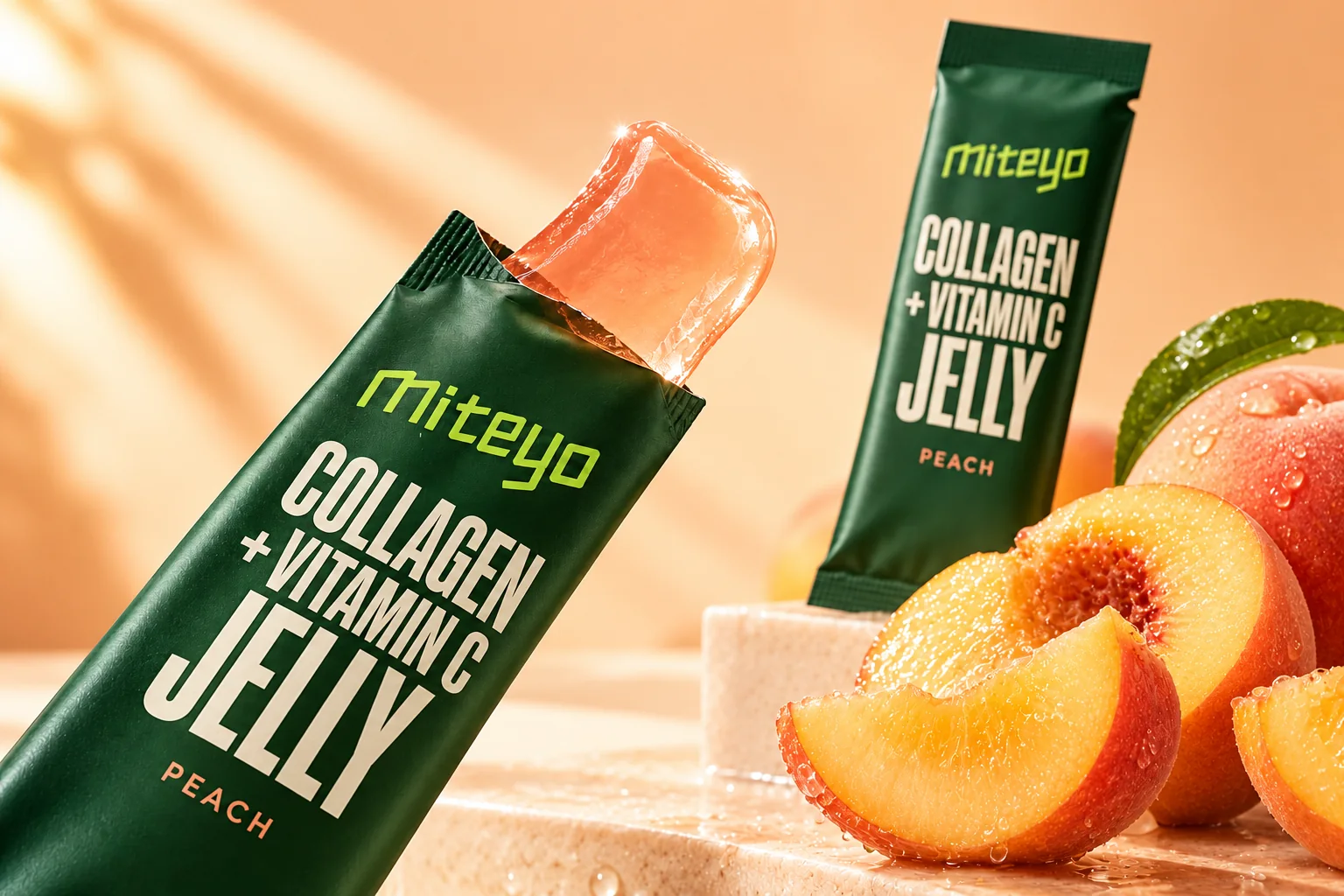
Define the routine and category role
Active Wellness can connect a daily jelly with a broader movement-oriented brand range. A proposed 20–25g net fill gives the development team a clear portion brief, while collagen and vitamin C amounts remain separate formulation decisions. Identify the intended consumer, occasion and retail category before commissioning artwork.
BB LAB’s official listing provides an example of collagen sold in a 20g jelly stick. That is evidence of a commercial format, not validation of a proposed MITEYO formula, a specific consumer outcome or the right serving for a new brand. Compare the experience and portion format without copying the competitor’s blend or marketing promises.
Explain vitamin C accurately
NIH ODS identifies vitamin C as necessary for collagen biosynthesis. This physiological role is a reasonable starting point for a formulation discussion, but it does not show that adding vitamin C to a particular collagen jelly produces a guaranteed skin, joint or exercise benefit. Review the finished wording against the destination market and supporting evidence.
Ask the development team to specify the vitamin form, proposed amount, analytical method and retained-content plan. NIH also notes that vitamin C content can be affected by storage and cooking. For the proposed jelly, evaluate the actual processing and packaged storage conditions rather than assuming the input amount equals the end-of-shelf-life amount.
Keep collagen separate from a muscle-protein proposition
Collagen should not be treated as interchangeable with whey for a muscle-protein brief. In a randomized study in healthy older women, Oikawa and colleagues found that whey produced greater increases in both acute and longer-term muscle protein synthesis than collagen peptides, under the studied feeding and resistance-exercise conditions. The study does not test a jelly and should not be stretched into a universal result across products and populations.
For buying purposes, separate the net jelly weight, collagen ingredient amount, declared protein and any proposed benefit claim. If the brand wants a muscle-building protein product, reassess the ingredient system, serving and evidence independently. Do not rename a small collagen jelly as a whey-equivalent post-workout protein serving.
Qualify source, sensory performance and the primary pack
Request collagen species/source identification, peptide specification and supplier traceability. Review source-dependent allergen declarations, dietary suitability and any certification claim for the actual ingredient and manufacturing scope. A fish collagen ingredient requires a different suitability discussion from a bovine source; “collagen” alone is not a complete purchase specification.
Evaluate the active-containing sample for aroma, aftertaste, bite, appearance and pack release. Confirm the proposed wrapper’s protection and seal performance with the finished formula, and include vitamin C retention and agreed microbial tests in the study plan. Record formula, source and package changes so a later substitution does not silently bypass approval.
Buyer checklist before sample approval
- Define Active Wellness positioning, intended market and proposed 20–25g net jelly fill.
- Specify collagen source, ingredient amount, composition documentation and traceability.
- Confirm source-dependent allergen, dietary and certification requirements with evidence.
- Specify vitamin C form, proposed amount, assay and retained-content study plan.
- Evaluate active-containing sensory samples and packaged stability with agreed criteria.
- Review artwork so jelly weight and collagen content do not imply whey-equivalent muscle nutrition.
Frequently asked questions
Does 20g of collagen jelly mean 20g of collagen?
No. Net jelly weight includes the entire formulation. Collagen content and any protein declaration need their own documented basis.
Can vitamin C guarantee a collagen-jelly benefit?
No. Its role in collagen biosynthesis does not establish a guaranteed result from a finished product. Proposed claims need product-relevant evidence and market review.
Can a collagen jelly be called vegan?
Do not assume so. Confirm ingredient origin and the basis for any dietary claim. A plant-derived gelling system does not change the origin of an animal-derived collagen ingredient.
References and scope of evidence
References reviewed 21 October 2026. Brand listings document market examples only; they do not establish sales volume, clinical efficacy or MITEYO capabilities. Research findings apply to their studied ingredients, populations and conditions, not automatically to a proposed finished jelly.
- BB LAB: Collagen Tangle Up Jelly, 20g sticks
- NIH ODS: Vitamin C fact sheet
- Oikawa et al. (2020): whey and collagen peptides in healthy older women