
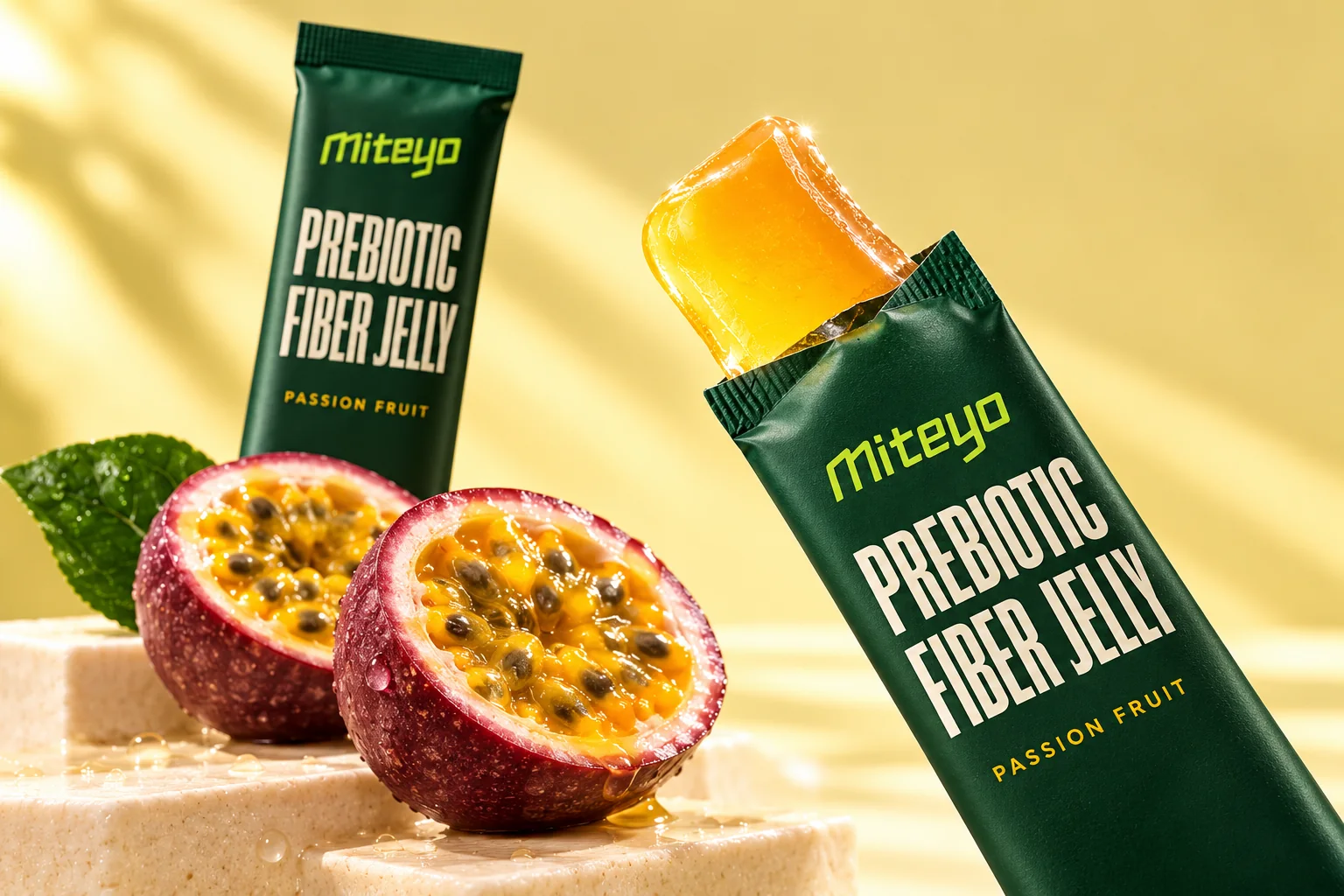
Specify the fiber rather than a generic gut-health blend
A fiber jelly request should name the candidate ingredient, supplier specification and proposed amount per stick and per day. Keep a proposed 25g net jelly fill separate from grams of dietary fiber. Ask how the ingredient contributes to texture, soluble solids and the declared nutrition panel rather than accepting the ingredient input as the final fiber declaration.
Choose one primary consumer routine and define sample acceptance around it. A daily wellness jelly, a product used around travel and a sports-adjacent range extension may need different instructions and expectations. Avoid combining unrelated ingredients simply to imitate a long competitor label.
Distinguish dietary fiber from prebiotic evidence
The ISAPP consensus defines a prebiotic through selective use by host microorganisms together with a health benefit. A fiber name alone does not establish that a finished jelly qualifies for a prebiotic claim. Ask for evidence that matches the specific ingredient and proposed amount, and check whether processing or other formulation changes affect the evidence assessment.
FDA’s dietary-fiber guidance and questions explain that labeling depends on the applicable definition and the specific carbohydrate. For a U.S. brief, confirm the status and declaration basis for the chosen material; for other destinations, perform the relevant local review. A prebiotic evidence discussion does not replace the nutrition-label assessment.
Use commercial examples without copying weight-loss claims
FOODOLOGY’s official Coleology page and Herbaland’s jelly range show fiber-related jelly products in commercial use. They can inform a discussion of portioned delivery and consumer routines. Their listings do not demonstrate sales volume, validate a new formulation or establish that a competitor’s claim is suitable for another market.
A new fiber jelly brief does not need to copy garcinia, slimming, detox or rapid bowel-movement promises. Keep the ingredient and claim selection tied to the intended routine and evidence. If the brand wants a different digestive outcome, write that as a separate evidence question rather than inheriting it from a reference pack.
Evaluate tolerance, texture and wrapper together
Set a structured sample-feedback plan that records the intended stick count, overall eating experience and any digestive discomfort reported during an appropriately reviewed evaluation. Bonnema and colleagues (2010) compared native chicory inulin and shorter-chain oligofructose and found gastrointestinal tolerance depended on the tested ingredient and amount consumed; one oligofructose condition increased symptoms compared with control. These findings support ingredient- and intake-specific review, not a universal tolerated amount or a no-bloating claim for fiber jellies. Evaluate the complete proposed formula, including other fibers and sweeteners, and the intended total daily intake. Do not treat a positive taste panel as a tolerance or efficacy study. Obtain qualified review of proposed use instructions and the suitability of the ingredient system for the intended users.
Compare the actual active-containing jelly for firmness, water separation, uniformity, residue and ease of dispensing. Ask the team to justify process controls and proposed microbial criteria. Define seal, leak, transport and storage checks using the intended wrapper and carton configuration. A material name such as “high barrier” is not a substitute for finished-pack evidence.
Make the approval package usable for repeat orders
The approved specification should connect ingredient identity, analytical method, fill controls, texture criteria, primary-pack revision and label declaration. Record the sample version and test batch so procurement can distinguish a reference sample from a production release specification.
Ask for a written change-control process if the fiber supplier, grade, flavor system, gelling system or wrapper changes. Obtain a project-specific quotation and validation schedule after the brief is defined. Neither a 25g target portion nor an attractive competitor pack proves the commercial MOQ, shelf life or manufacturing readiness of a new project.
Buyer checklist before sample approval
- Separate proposed 25g net jelly fill, fiber ingredient input and declared dietary fiber.
- Identify the exact fiber grade, supplier specification and intended daily stick count.
- Review prebiotic evidence separately from the target-market dietary-fiber declaration.
- Agree sensory and appropriately reviewed tolerance-feedback procedures and use instructions.
- Request process, microbial, shelf-life and finished-wrapper verification with sample traceability.
- Approve source, label and packaging change control before a repeat-order specification is fixed.
Frequently asked questions
Is every fiber a prebiotic?
No. The scientific prebiotic definition includes selective microbial use and a health benefit. Review evidence for the actual ingredient rather than relying on the generic word fiber.
Does a 25g jelly contain 25g of fiber?
No. That is a proposed net fill weight. Fiber ingredient mass and declared dietary fiber require separate formulation and analytical documentation.
Must a fiber jelly include garcinia or slimming claims?
No. Ingredient selection and positioning should follow the intended routine, evidence and target-market review. A competitor’s formula or claims are not a required template.
References and scope of evidence
References reviewed 21 October 2026. Brand listings document market examples only; they do not establish sales volume, clinical efficacy or MITEYO capabilities. Research findings apply to their studied ingredients, populations and conditions, not automatically to a proposed finished jelly.
- Gibson et al. (2017): ISAPP consensus on prebiotics
- FDA: Questions and Answers on Dietary Fiber
- Bonnema et al. (2010): Gastrointestinal tolerance of chicory inulin products
- FOODOLOGY: Coleology Bowel Movement Jelly
- Herbaland: Jelly Sticks category