How to Choose an Oral Dissolving Strip Manufacturer in China
Learn how to assess an oral strip manufacturer in China using supplier documents, sample testing, traceability and market-specific qualification questions.
 Start a project ↗
Learn how to assess an oral strip manufacturer in China using supplier documents, sample testing, traceability and market-specific qualification questions.
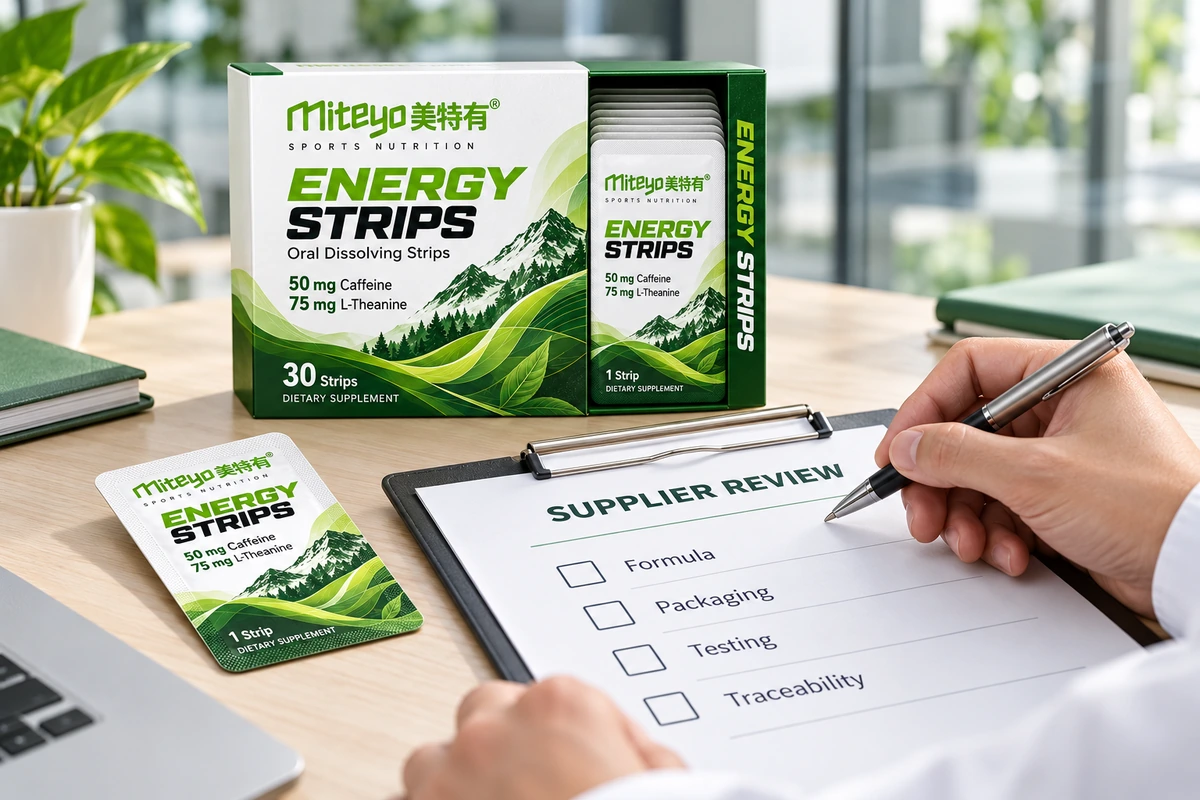
Choose an oral dissolving strip manufacturer by verifying the people, processes and evidence behind the proposed product, rather than relying on a catalogue, factory photograph or certificate logo. Establish who will formulate, manufacture, pack, test and release your order, including any subcontracted activities. Then assess representative samples against an agreed specification and connect the results to the proposed production and packaging system. For US and European brand buyers, supplier qualification also needs a clear division of responsibility for ingredient suitability, labels, claims and destination-market requirements. A useful shortlist is built from documented answers and unresolved risks. An impressive presentation can start a discussion, but it cannot replace project-specific records, traceability or a workable change-control agreement before commercial commitment.
The company answering an inquiry may perform several roles, or coordinate work done by other organizations. Ask for the legal contracting entity and a process-responsibility map. Identify which activities are performed at which site and who is accountable for records, deviations and release decisions.
This is a verification task, not a reason to assume that every outsourced activity is unacceptable. A clearly defined specialist arrangement can be evaluated. An unexplained gap between what the sales team promises and who actually performs the work is harder to manage.
Request a process walkthrough relevant to your proposed oral film. Discuss material receipt, formulation preparation, film formation, conversion into units, primary wrapping, secondary packing and quality review as applicable to the actual process. Avoid requiring a supplier to fit an imagined universal production line.
MITEYO's manufacturer page describes the commercial development discussion. Ask for evidence applicable to the specific project and facility rather than interpreting the page itself as an audit report.
A document is useful only when you know what it covers. Record the issuing organization, named entity, site, scope and validity where those fields apply. Check whether the document relates to the product and activities being proposed. A logo on a presentation does not answer these questions.
For US dietary supplements, FDA's CGMP guidance explains requirements involving specifications, quality controls and records. Use the applicable requirements to guide qualification; do not describe an unverified supplier as “FDA approved” or infer finished-product compliance from facility marketing.
For EU projects, identify the actual destination countries and responsible market participants. Ask who will evaluate ingredient status and the proposed claims. The Commission's Novel Food Status Catalogue is explicitly non-binding; it is a reference for investigation, not a blanket approval of a formula or delivery format.
Give each requested item a status: received and reviewed, clarification required, verification required, or not applicable with a reason. Record the reviewer and next action. This prevents a general sales statement from quietly becoming an accepted quality assumption.
Where information is confidential, agree an appropriate way to review it. A redacted example, controlled audit discussion or other suitable arrangement may be possible. The important outcome is a defensible understanding of the relevant control, not a folder filled with documents nobody has interpreted.
A supplier sample can be useful for discussing appearance and handling, but first establish what it represents. Is it your formula, a reference formula or simply a packaging example? Does it use the intended material system and wrapper? What changes are expected before production?
Ask for an agreed sample plan addressing active content and unit uniformity, relevant microbiological assessment, film integrity, sensory review, packaging seal and the intended stability program. Applicable methods and limits must be defined for the product; this checklist does not prescribe universal numerical thresholds.
Review the relationship between the sample and a future manufacturing batch. A sample approval should identify the version, acceptance criteria and unresolved items. It should not be treated as permission to substitute materials or change packaging without review.
A qualification discussion becomes more informative when it covers an exception. Ask how an out-of-specification result, damaged wrapper or unexpected sensory issue would be investigated, documented and communicated. Who decides whether material is held, rejected or reworked where appropriate?
The answer should identify responsibility and a controlled decision process. A promise that problems never occur is less useful than a clear explanation of how the organization handles one. Request relevant evidence without asking the supplier to disclose another customer's confidential information.
| Qualification area | Evidence or question | Hold the decision when |
|---|---|---|
| Contracting identity | Which entity contracts and which site performs each activity? | Roles or locations remain unexplained |
| Process capability | How is this formulation evaluated through actual processing steps? | A generic equipment list substitutes for the discussion |
| Raw materials | How are identity, specifications and supplier changes controlled? | Inputs cannot be connected to agreed requirements |
| Sample relevance | What formula, wrapper and version does the sample represent? | Approval would apply to an unidentified sample |
| Testing | Which methods, laboratories and acceptance criteria apply? | “Tested” is stated without a defined scope |
| Packaging | What supports seal, compatibility and storage decisions? | A material name is the only supporting evidence |
| Traceability | Can materials, batch records and shipped units be connected? | Records cannot support a credible trace exercise |
| Changes and complaints | Who approves changes and investigates complaints? | Responsibilities and escalation paths are absent |
| Market documentation | Who reviews ingredients, labels and claims for each destination? | Approval is assumed to transfer between markets |
Use this as a working procurement checklist. It is not a certification of any supplier, including MITEYO. Items without current approved evidence remain marked “verification required.”
The order should refer to a defined specification and approved versions of packaging artwork. Clarify who may authorize changes to ingredients, suppliers, manufacturing arrangements, testing, packaging materials or product presentation.
Set expectations for notification and assessment before a change is implemented. A change may be commercially reasonable yet still affect previous sample or stability conclusions. Ask how the parties will determine which evidence must be revisited and how revised approval is recorded.
Also agree the documentation accompanying shipment and the process for resolving discrepancies. A certificate of analysis, where applicable, should be relevant to the material or batch it describes. Its presence alone does not answer every question about production control or market suitability.
Identify the contact responsible for quality complaints and the information required to investigate them. Establish how sample retention, batch identification and distribution records will support that process. Clarify how findings and corrective actions are communicated to the brand.
For an overseas buyer, these arrangements matter after the shipment arrives. A purchasing relationship should not end at dispatch when the brand still needs technical information, traceability or support investigating a concern.
Send the same concise project brief to shortlisted suppliers. Ask each to identify the largest unresolved technical and packaging issues, what evidence would resolve them and which activities are included in the proposed development scope.
Compare the quality of clarification, not just response speed. A supplier that asks about serving size, ingredient form, destination market and wrapper requirements is helping define the problem. An unconditional promise made without those details should prompt further questions.
MITEYO's manufacturing-process overview can support that discussion, while the oral-strip hub connects formulation, packaging and OEM/ODM development. These resources explain the questions to explore; supporting facility and project documents should still be requested and verified.
No. Verify the underlying document, named entity, scope and current applicability. Qualification also requires evidence relevant to the formulation, packaging and activities proposed for your order.
Not automatically. Identify the activity, responsible organization and controls. An arrangement can be assessed when roles, records and quality responsibilities are clear; undisclosed arrangements create avoidable uncertainty.
No. A sample can support specific product observations, but it does not establish all manufacturing controls, traceability or destination-market requirements. Define what each piece of evidence can and cannot demonstrate.
Provide the target countries, intended formula and packaging brief, then request the relevant development scope, process responsibilities and supporting documents. Mark any unsupported accreditation or capability statement for verification before relying on it.
Start a Project with MITEYO and include the qualification checklist most relevant to your business. Ask for the evidence needed to make a purchasing decision, with unanswered items clearly identified rather than replaced by generic assurances.