How to Launch a Five-Product Oral Strip Supplement Line
Plan a five-product oral strip line with clear SKU roles, formula reviews, coordinated packaging and practical launch gates for supplement brand buyers.
 Start a project ↗
Plan a five-product oral strip line with clear SKU roles, formula reviews, coordinated packaging and practical launch gates for supplement brand buyers.
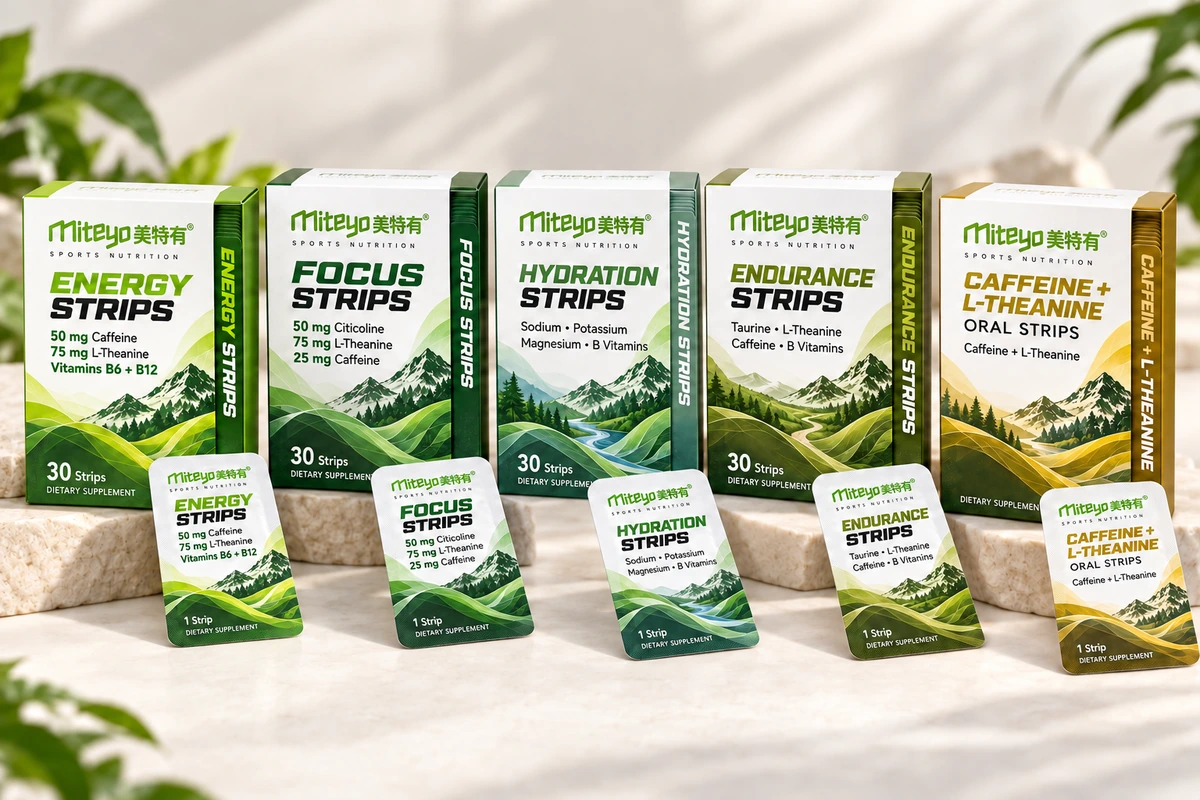
Launch a five-product oral-strip line by building one coordinated commercial plan and five separately reviewed product specifications. Start with the customer role of each SKU, then evaluate technical feasibility, destination-market suitability, packaging and economics before committing to the complete assortment. Shared artwork or carton dimensions can simplify coordination, but they do not establish that different formulas can use the same process, serving or testing conclusions. A practical sequence is to identify a priority SKU, resolve its development risks, and use the lessons to improve the remaining briefs without assuming their approval. This guide uses Energy, Focus, Hydration, Endurance and Caffeine + L-Theanine as a portfolio-planning framework; each product still needs its own confirmed formula, label and manufacturing requirements before launch.
Five products should solve five understandable customer needs, not merely fill five spaces in a display. Begin with the intended audience, occasion and role of each product. Then ask whether a customer or retail buyer could explain the difference without reading a long ingredient list.
Energy and Focus, for example, need clear positioning boundaries if both appear in a range. Hydration and Endurance also require distinct intended routines and carefully reviewed wording. Caffeine + L-Theanine needs a defined role alongside Energy and Focus rather than being added simply to fill a fifth position.
These five names refer to existing website product pages, not five newly created products. See Energy, Focus, Hydration, Endurance and Caffeine + L-Theanine. Their published ingredient information is the starting point; the product name alone does not determine market-specific claims or serving directions. Where actual formulas are already available, attach their approved specifications to the corresponding SKU brief. Do not let a shared visual identity obscure meaningful differences in use or formulation.
MITEYO's private-label oral-strip route provides a starting point for discussing a coordinated range. The objective is to connect brand strategy with five workable development decisions, not to assume a finished assortment from five attractive package fronts.
Use a portfolio worksheet that compares the same questions across all five products. Assign an owner to every unresolved item and record evidence separately from the team's expectation.
| Product role | Demand question | Technical or market question | Decision before launch |
|---|---|---|---|
| Energy | Which specific occasion motivates purchase? | Does the intended serving and positioning suit the market? | Confirm the core offer and directions |
| Focus | How is the offer meaningfully different from Energy? | Can the proposed ingredient system meet the film brief? | Resolve overlap and feasibility |
| Hydration | When does a light electrolyte format add convenience? | Does the serving avoid implying replacement of a full hydration drink? | Define its supporting role |
| Endurance | How is the longer-session occasion different from Energy? | Are the intended ingredients and repeated-use directions suitable? | Clarify the role and serving |
| Caffeine + L-Theanine | What differentiates it from the existing Energy and Focus offers? | What combined serving is justified and feasible? | Resolve overlap before adding inventory |
Add commercial columns for expected channel, packaging complexity, inventory exposure and differentiation. Do not turn the worksheet into a formula that hides a serious regulatory or technical obstacle behind a high marketing score.
The hero SKU should be the product with the clearest evidence path, not necessarily the most visually striking name. It can establish the purchasing and review workflow while the other products progress according to their own requirements.
Common visual hierarchy can make a range easier to understand. Place the product name, identity and directions consistently, while using clear variant differentiation. Check the designs together in a realistic retail setting; colors that look different on a monitor may be less useful at a small viewing size.
Shared pack dimensions may simplify artwork and display planning, but the right primary package still depends on the film. Ask whether common dimensions and materials are appropriate for each formulation. Do not transfer a packaging conclusion across the range without review.
Possible discussion options include individual barrier sachets in paper cartons, a carton with a hanging feature for a suitable retail channel, or a shelf-ready countertop display. These are packaging choices to evaluate, not a claim that one construction is always cheaper or technically superior. Any alternative to a confirmed pack should remain subject to project review.
Paper cost advantages are project-dependent. Printing, finishing, assembly, protection and shipping configuration all matter to the comparison. Request a defined quotation before using packaging material alone to forecast savings.
The current oral-strip packaging discussion can guide the specification. Use the existing approved pack as the baseline when available, and record why a new channel would require a change.
Reducing flavor variations can reduce the number of sensory directions to coordinate, but one flavor system may not work equally well with different ingredients. Ask for a formulation-specific response rather than requiring the same flavor solely for purchasing convenience.
Likewise, the same strip count need not mean the same serving pattern. Keep amounts per strip, strips per serving and pack count separate in the master data. Clear separation helps prevent artwork errors when the range is reviewed as a group.
Create a controlled SKU sheet for each product containing the formula version, material specifications, intended market, approved name, pack configuration, artwork version and required tests. Link the sheets to a shared range plan, but do not replace them with one generic family specification.
Define the first sales channel, destination countries and role of each SKU. Identify non-negotiable formulation requirements and where alternatives are acceptable. Record the expected order mix and desired schedule as brand requests awaiting commercial confirmation.
MITEYO's oral-strip development hub brings together formulation, process and packaging questions. Use that discussion to assign the work needed before a quotation or sample can be treated as representative.
Evaluate each sample against its own criteria for sensory experience, handling, analytical assessment and packaging. Then conduct a separate range-level review of identification, opening convenience and the clarity of the proposed directions.
Keep consumer feedback proportionate to the method used. A small exploratory exercise can reveal confusion or a recurring complaint, but it is not a universal acceptance percentage. Record the sample version and context so that the feedback can inform a specific revision.
Confirm the formula, claims review, artwork, packaging specification and applicable testing scope before ordering final printed materials. An attractive draft carton should not become the approval record for an unresolved formula.
Maintain a change log across procurement, manufacturing and brand teams. If a component changes, identify which products and earlier approvals are affected. A shared carton template makes design coordination easier, but it also means a mistaken edit can spread across several SKUs unless versions are controlled.
A five-product plan does not require every SKU to launch simultaneously. Consider whether a priority product or smaller initial assortment can answer important commercial questions before a wider commitment. Do not present this approach as a promised reduction in MOQ, price or manufacturing time; those conditions require agreement.
Ask the retail channel how replenishment will work. A display that looks balanced on launch day may sell unevenly. Plan how individual variants can be reordered and how changes in the assortment affect packaging, records and commercial assumptions.
Use one cover brief plus five product sheets. The cover brief should identify the intended countries, launch channel, common design system, preferred packaging construction and requested quotation basis. The individual sheets should specify ingredients, target serving, variant-specific requirements and unresolved questions.
Ask the quotation to distinguish:
Avoid adding five unit prices and calling the result a launch budget. Identify development, setup, logistics and other relevant responsibilities separately, and make sure the quoted unit is defined consistently.
The US, individual EU destinations and other markets may require different ingredient and label decisions. For EU work, use the European Commission's health-claims information as one input to qualified review. For US work, refer to FDA's structure/function claim guidance. Neither resource approves the five-SKU framework or a package illustration.
Specify who reviews each destination and who approves the final wording. Do not assume that a previously reviewed Energy product establishes the suitability of Hydration, Endurance or Caffeine + L-Theanine ingredients and claims.
No. A staged assortment can be considered when it helps resolve technical or commercial uncertainty. Confirm the manufacturing and purchasing implications with the supplier rather than assuming that staging changes commercial terms automatically.
It can be explored, but sensory performance must be assessed for each formula. Different ingredients can create different taste and mouthfeel challenges even with a shared flavor direction.
Not necessarily. Review which material, seal, compatibility and stability conclusions apply to each product. A common carton design does not establish that every film is equally suited to the same primary wrapper.
Prepare the common commercial brief and a separate sheet for each formula, serving and packaging requirement. Mark assumptions clearly so the quotation can identify its basis and any outstanding development work.
Send MITEYO your range plan and individual SKU briefs. Start a Project to discuss development priorities, sample scope and packaging coordination. A coherent range begins with clear product roles and separately controlled specifications, then earns its final assortment through evidence.