
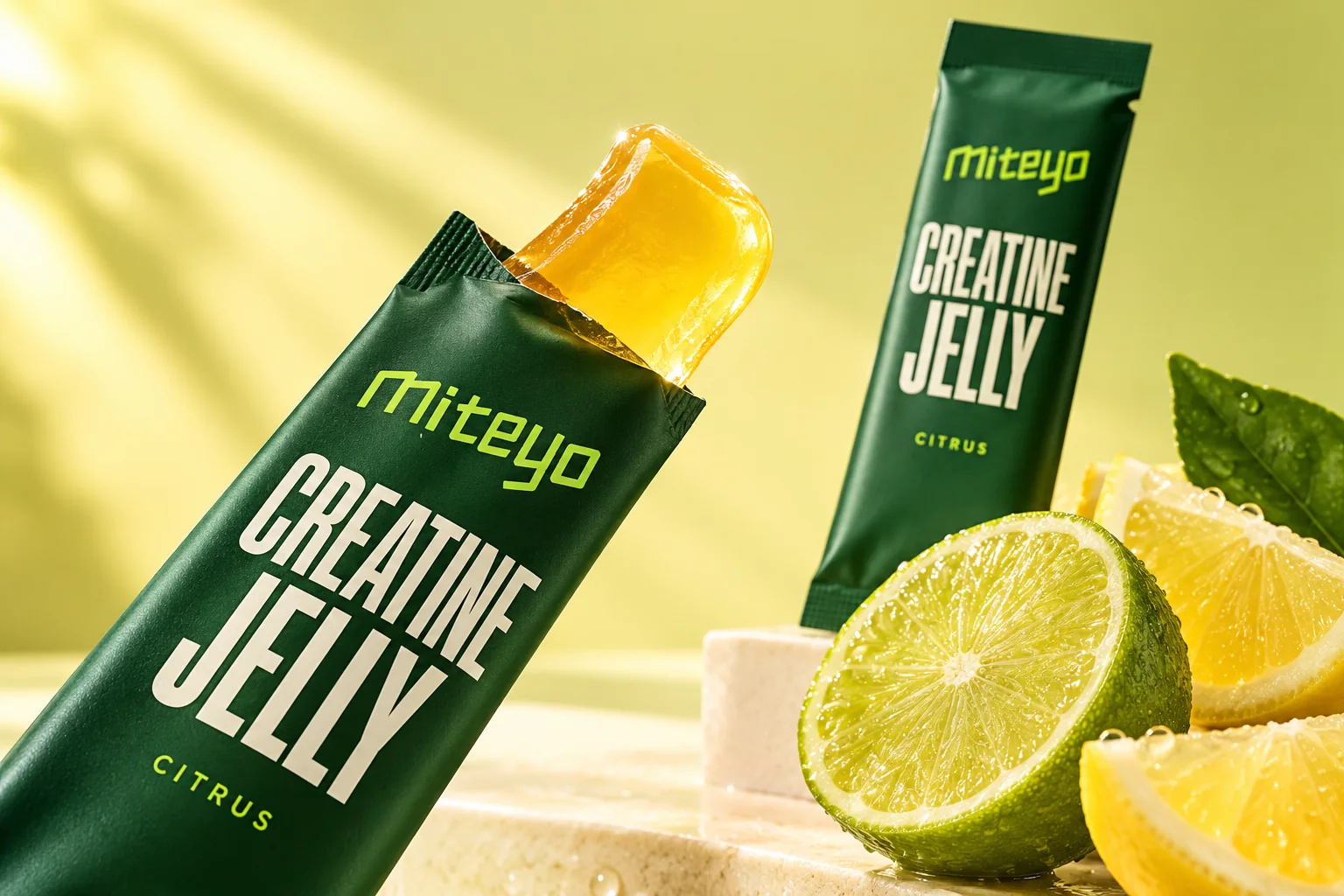
Start with the question the sample must answer
A proposed 20–30g jelly stick is a convenient physical format to investigate, but the central buying question is whether the intended creatine serving remains within specification in the final packaged product. Define the ingredient form, declared-content basis and intended daily stick count before choosing a target fill.
Interest from brand buyers can justify a prototype program. It does not prove marketplace sales, commercial feasibility or an established MITEYO creatine jelly process. Keep milestones separate: bench feasibility, pilot reproducibility, packaged stability and commercial release. Do not print a finished active claim or shelf life simply because a proposed amount fits on paper.
Why a water-containing matrix needs its own data
Ganguly and colleagues studied creatine in solutions made from effervescent formulations and observed changes during storage under the study conditions. Uzzan and colleagues examined creatine degradation in model systems across water activity and temperature conditions. These original studies identify reasons to investigate the actual matrix; neither validates a commercial jelly formulation.
Request a study of the chosen ingredient, final pH, water activity, processing exposure, storage conditions and primary package together. Measure the relevant variables rather than choosing a universal pH or heat limit from a different product. A change made to improve texture or microbiological control may also require the creatine retention plan to be reconsidered.
Design a staged analytical sampling plan
Agree sampling points that can distinguish raw-input quality from processing and storage effects: ingredient receipt, a defined intermediate where useful, post-process product, packaged release and planned storage intervals. Use traceable sample IDs and retain the process record for each trial. The laboratory should confirm that extraction and quantification work for the jelly matrix.
Ask how the method distinguishes creatine from creatinine, and define suitable reporting units and acceptance criteria with qualified technical reviewers. Sampling should also assess variability between sticks. Do not substitute total ingredient input, nitrogen content or a raw-material COA for a finished-product creatine result. Any proposed overage requires documented justification and applicable regulatory review.
Approve the package and shelf life as a system
Inspect appearance, texture, separation, flavor, seal integrity and microbiological results alongside the chemical assay. Include the proposed wrapper, fill conditions and realistic distribution scenario. Define a real-time stability program and the storage claim before starting; a shorter accelerated trial should not automatically be converted into a long shelf-life statement.
If the pilot cannot meet the agreed criteria, revise the brief or stop the jelly route. Brands can compare the existing creatine powder category while assessing tradeoffs, without assuming that powder stability transfers to jelly. Keep unresolved stability questions visible in the quotation, sample report and artwork approval workflow.
Buyer checklist before sample approval
- Define creatine form, declared-content basis, proposed daily serving and 20–30g net fill.
- Record final matrix pH, water activity, process conditions and package revision for each trial.
- Obtain a matrix-suitable method that distinguishes creatine and creatinine.
- Agree release and storage sampling, reporting units and acceptance criteria before testing.
- Review chemical, microbial, sensory and seal results together, with traceable stick samples.
- Keep shelf-life and production claims provisional until supported by the agreed evidence.
Frequently asked questions
Does creatine powder evidence prove a jelly is stable?
No. A water-containing jelly, its process and its package require their own supporting data. A raw-material certificate confirms only the scope stated on that document.
Can a fresh sample establish a long shelf life?
No. It can support an initial feasibility decision. A shelf-life claim needs an appropriate study and technical justification for the final product and storage conditions.
Is adding more creatine a substitute for stability work?
No. Any overage needs justification and applicable review. It does not remove the need to understand degradation, uniformity and retained content over time.
References and scope of evidence
References reviewed 21 October 2026. Research findings apply to their studied ingredients, populations and conditions, not automatically to a proposed finished jelly.
- Ganguly et al. (2003): stability of creatine in solution
- Uzzan et al. (2009): water activity, temperature and creatine stability