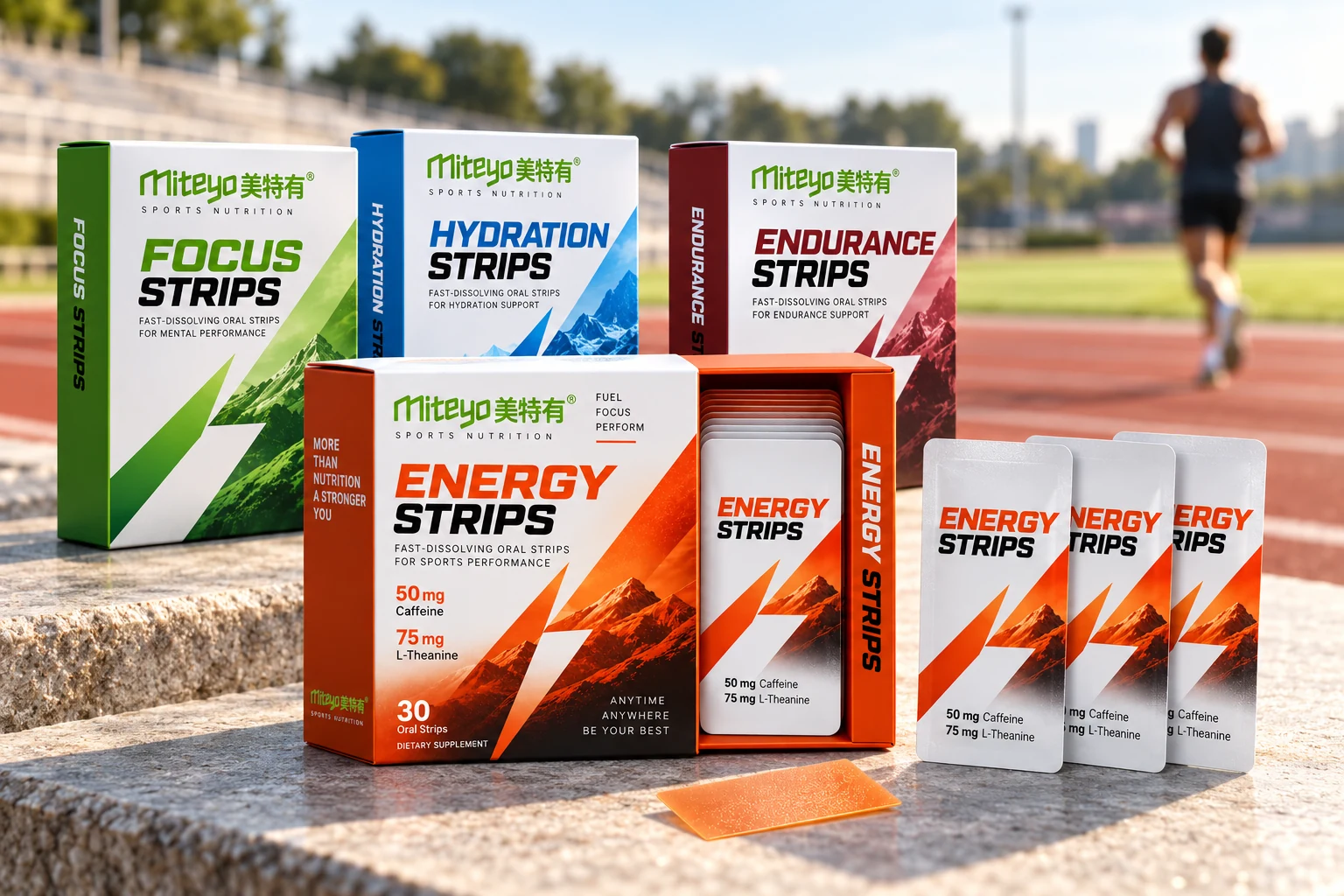
Energy and Focus Oral Strips: How to Write Two Distinct Product Briefs
Develop a clearer oral-strip range by separating customer occasions, ingredient requirements, sensory expectations and packaging decisions for Energy and Focus concepts.
MITEYO Editorial Team · Oral Strips
Start with two different customer occasions
Energy and Focus can be useful names for product-development directions, but changing the name and pack color does not by itself create a distinct product. Write a separate customer occasion for each concept. Where will it be used, what routine will it join and why would the customer select that variant? Treat those statements as hypotheses to review. They are not evidence that a proposed formula delivers a particular effect.
Specify what is fixed and what can change
For each brief, list the requested ingredients, target amount per serving, intended number of strips, flavor preferences and destination markets. Separate essential requirements from options. If a requested serving is not suitable for the proposed film, the team needs room to discuss a revised specification or a different format. Do not assume that the same serving, film size or packaging count can be copied across both variants. A complete proposal depends on the particular ingredient system and development review.
Keep positioning and technical review connected
Describe the intended positioning in plain language and submit the proposed label wording for market-specific review. Product names, images and usage instructions should tell a consistent story. Do not treat fast mouth dissolution as evidence of faster absorption or a stronger effect. Likewise, ingredient familiarity does not replace evidence for the finished product. The development brief should identify unanswered questions before the design team turns a concept into apparently finished commercial artwork.
Design a range customers can navigate
Keep the MITEYO or private-label brand system consistent while giving each variant a clear name and visual cue. Evaluate the outer carton and the individual sachet separately: a customer may carry a sachet without the carton. Check that the variant remains identifiable at that size. Avoid relying only on color to distinguish products. Use the same information hierarchy across both packs, then confirm that the proposed content and instructions match each approved specification.
Compare samples and commercial scope fairly
Ask for a separate sample record and commercial scope for each variant. Review flavor, handling, packaging interaction and the outstanding testing questions against its own brief. When comparing quotations, align the assumptions about serving count, packaging, artwork, sample work and documentation. A difference in quoted price may reflect different scope. Resolve that difference before choosing which concept to advance. You can launch one validated direction first and develop the second later if that better fits your project.
Build the next conversation around a decision
Bring MITEYO two short briefs with the customer occasion, target market, requested ingredients and serving, packaging preferences, expected first order and launch priorities. State the decisions you need help making. Review the Energy and Focus product pages as development starting points, then request project-specific feasibility and samples. A small, clearly differentiated range is easier to assess when each variant has an explicit purpose, an approved specification and its own development record.
 Start a project ↗